
Working with advanced options
Letzte Aktualisierung: 30.09.2026The advanced edit mode offers further tools for customizing your sheet, as well as alternative options for working with sheets.
If you have used previous versions of Qlik Sense, you will recognize Advanced options as the previous sheet editor. The advanced edit mode contains all the features and properties previously available when editing sheets.
Unlike standard options, the advanced edit mode offers a grid on which you can drag and drop visualizations and extensions. You can then resize the visualizations to fit the preferred number of grid squares. The advanced edit mode also supports touch-only devices, unlike standard mode.
Sheet in the advanced edit mode.

Click Advanced options to switch between standard and advanced options. This allows you to develop a hybrid approach for your sheets. If you change the layout settings in the advanced edit mode, the sheet will be locked in the standard edit mode for layout editing.
The following tasks can be done in the advanced edit mode:
-
Edit the sheet properties, such as title, description, and thumbnail.
-
Add a background color or image to a sheet.
-
Change visualization properties, such as sorting and styling.
-
Copying and pasting visualizations or visualization styling.
-
Adding multiple expressions as dimensions or measures in a visualization.
-
Add custom objects to a sheet.
-
Setting show conditions for sheets.
-
Adjust grid size and layout of a sheet.
-
Add actions to a sheet.
Some visualizations can only be added in the advanced edit mode:
-
Button
-
Text & Image
-
Container
-
Analyses
-
Custom objects, such as extensions from the Dashboard bundle or Visualization bundle.
You can perform many of the same actions in advanced edit mode as you can in the standard edit mode, although there are some differences. Some of the same actions are applied in different ways. For example, visualizations are added to sheets by dragging and dropping them onto a grid in the advanced edit mode. Some actions, like filters, can only be applied in standard mode. Some sheet properties can only be set in advanced mode.
Creating a new sheet
You can create a new sheet from the application overview or from the assets panel.
Gehen Sie folgendermaßen vor:
- From the application overview, click
 to view the sheets.
 - Click
 or Create new sheet.
 - Give your sheet a title and add a description.
- Click outside the text area to save the title and description.
A new sheet is created. Your sheets are private until you make them public. For more information, see Gewähren von Zugriff auf Arbeitsblätter, Arbeitsblattgruppen, Lesezeichen und Storys.
Setting sheet properties
You have a wide range of ways to style your sheet and change sheet behavior in advanced mode. For more information, see the following:
Creating visualizations
Gehen Sie folgendermaßen vor:
-
In edit mode, drag the visualization from the assets panel onto the sheet or double-click the visualization.
-
Add dimensions and measures to the visualization.
You can add dimensions and measures using the buttons on the visualization. You can also drag a field from the Fields tab of the assets panel and then select it to use it as a dimension or measure The number of dimensions and measures that are required depends on which visualization you select.
If you want to add expressions as dimensions or measures, click in the properties panel, under Data, click add and then click
 .
. -
Adjust the presentation: for example: sorting, coloring, or labeling.
For more information, see Ändern der Darstellung einer Visualisierung.
Custom objects are added in a similar manner. You start creating a visualization by dragging a visualization extension onto the sheet. For more information, see Erstellen einer Visualisierung mit einem benutzerdefinierten Objekt.
You can use tab containers to save space on your dashboard, by quickly switching between tabs with different visualizations. For more information, see Registerkarten-Sammelbox.
The types of data you have in your tables and fields impacts whether they can be used as dimensions or measures.
- Dimensionen legen fest, wie die Daten in einer Visualisierung gruppiert werden. Beispiel: Gesamtumsatz pro Land oder Anzahl der Produkte pro Anbieter For more information, see Datengruppierung mit Dimensionen.
- Measures are calculations used in visualizations, typically represented on the y-axis of a bar chart or a column in a table. Kennzahlen werden aus einer Formel berechnet, die sich aus Aggregierungsfunktionen wie beispielsweise Sum oder Max zusammensetzt und mit einem oder mehreren Feldern kombiniert wird. For more information, see Kennzahlen.
Creating visualizations with analyses
Analyses allow you to build visualizations by starting with a type of analysis. You then select data for the analysis to use and then the analysis generates a chart. You can then adjust analysis-specific properties and style the visualization.
In analysis mode, analyses are identical to other visualizations.
Analyses are available from Analyses in the assets panel. For more information, see Erstellen und Bearbeiten von Analysen.
Creating visualizations with chart suggestions
Chart suggestions functions similarly to the autochart in the standard edit mode. You can turn on chart suggestions in the properties panel. When turned on, as you add or remove fields, the suggested visualization adjusts itself based on your changes. You can customize a suggested visualization with a focused set of properties.
For more information, see Visualisierungen mithilfe von Insight Advisor Diagrammvorschlägen erstellen.
Moving visualizations
Gehen Sie folgendermaßen vor:
-
Click and drag visualizations to reposition them on the grid.
Copying visualizations
In advanced options, you can copy and paste visualizations in the following ways:
- Using the edit bar on the sheet (
 ,
,  , and
, and  ).
). - By right-clicking and selecting Cut, Copy and Paste.
- With the keyboard shortcuts Ctrl+C, Ctrl+X and Ctrl+V.
Depending on what situation you are in, different things will happen when you paste a copied visualization on a sheet while using advanced options:
- If a visualization is selected, then the selected visualization will be replaced.
- If no visualization is selected, then the pasted visualization will be placed in the largest empty space.
- If there is no empty space, then the largest visualization on the sheet will be split in half to make space for the pasted visualization.
For more information about copying and pasting visualizations, see Kopieren einer Visualisierung aus einer vorhandenen Visualisierung.
Copying and pasting visualization styling
If you have applied custom styling to a visualization, you can copy its styling properties and paste them onto another visualization. For more information, see Kopieren und Einfügen von Visualisierungsdesigns.
Converting visualizations
You can convert visualizations by clicking and dragging them onto another visualization.
Gehen Sie folgendermaßen vor:
-
While editing a sheet, drag a new chart from the assets panel onto the visualization that you want to convert.
Das Shortcut-Menü wird geöffnet.
-
Select the conversion option.
Hinzufügen einer Hintergrundfarbe oder eines Bildes
Sie können den Hintergrund eines Arbeitsblatts anpassen. Sie können eine bestimmte Hintergrundfarbe oder eine Farbe nach Formel wählen. Jedes Bild in der Medienbibliothek kann als Hintergrund festgelegt werden. Das Bild kann so positioniert und in der Größe verändert werden, dass es nicht den ganzen Hintergrund füllt.
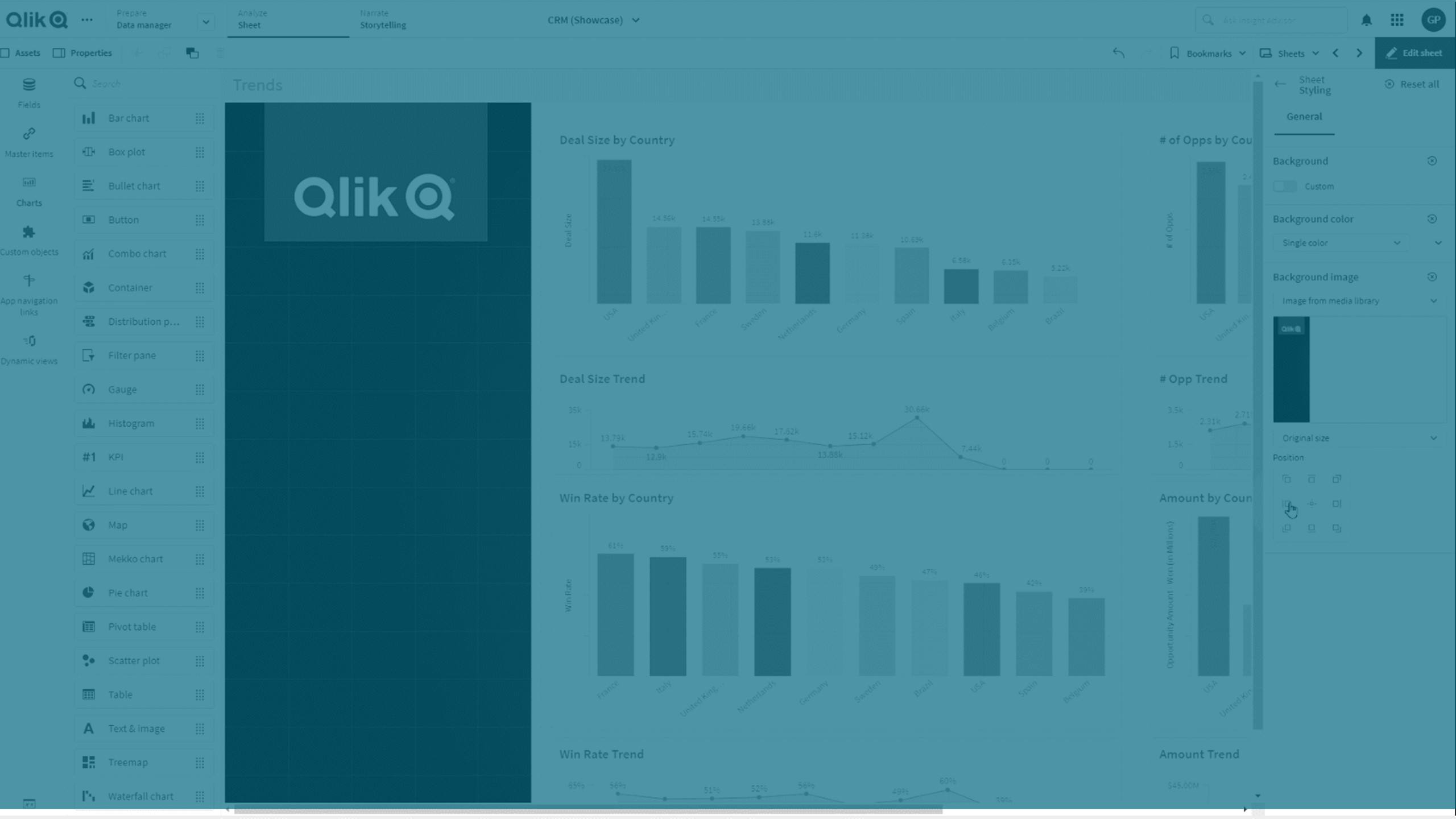
Die folgenden Formate werden unterstützt: .png, .jpg, .jpeg und .gif. Wenn Sie ein GIF verwenden, kann es animiert oder statisch sein.
Qlik Cloud Government unterstützt keine Hintergrundbilder oder -farben in Arbeitsblättern.
Gehen Sie folgendermaßen vor:
- Öffnen Sie das Arbeitsblatt im Bearbeitungsmodus.
- Klicken Sie unter Eigenschaften des Arbeitsblatts auf Designs.
- Legen Sie Hintergrund auf Benutzerdefiniert fest. Der Standard ist Auto.
-
Hintergrundfarbe:
-
Eine Farbe: Wählen Sie mithilfe der Farbauswahl eine Farbe aus.
-
Nach Formel: Legen Sie eine Farbe anhand einer benutzerdefinierten Formel fest. Weitere Informationen finden Sie unter Farbgebung nach Formel.
-
- Hintergrundbild: Wählen Sie Bild aus Medienbibliothek aus. Standard ist Keine.
-
Klicken Sie auf der Standardminiaturansicht auf
 .
.Die Medien-Bibliothek wird geöffnet.
-
Wählen Sie das Bild aus, das Sie verwenden möchten, und klicken Sie auf Einfügen.
Wenn sich das gewünschte Bild noch nicht in der Medienbibliothek befindet, klicken Sie auf Neuer Upload und fügen das Bild hinzu.
- Verwenden Sie die Dropdownliste, um die Größe Ihres Bilds zu ändern:
- Originalgröße
- Immer anpassen
- Auf Breite anpassen
- Auf Höhe anpassen
- Auf passende Größe strecken
- Immer füllen
- Unter Position können Sie die Ausrichtung des Bildes ändern. Beispielsweise kann das Bild auf dem Arbeitsblatt zentriert sein oder sich in der oberen rechten Ecke befinden.
Das ausgewählte Bild und die Hintergrundfarbe sind jetzt auf dem Arbeitsblatt sichtbar.
Arbeitsblatt im Bearbeitungsmodus, mit Hintergrundbild auf der linken Seite
