
Working with advanced options
Última actualización: 20/10/2026The advanced edit mode offers further tools for customizing your sheet, as well as alternative options for working with sheets.
If you have used previous versions of Qlik Sense, you will recognize Advanced options as the previous sheet editor. The advanced edit mode contains all the features and properties previously available when editing sheets.
Unlike standard options, the advanced edit mode offers a grid on which you can drag and drop visualizations and extensions. You can then resize the visualizations to fit the preferred number of grid squares. The advanced edit mode also supports touch-only devices, unlike standard mode.
Sheet in the advanced edit mode.

Click Advanced options to switch between standard and advanced options. This allows you to develop a hybrid approach for your sheets. If you change the layout settings in the advanced edit mode, the sheet will be locked in the standard edit mode for layout editing.
The following tasks can be done in the advanced edit mode:
-
Edit the sheet properties, such as title, description, and thumbnail.
-
Add a background color or image to a sheet.
-
Change visualization properties, such as sorting and styling.
-
Copying and pasting visualizations or visualization styling.
-
Adding multiple expressions as dimensions or measures in a visualization.
-
Add custom objects to a sheet.
-
Setting show conditions for sheets.
-
Adjust grid size and layout of a sheet.
-
Add actions to a sheet.
Some visualizations can only be added in the advanced edit mode:
-
Button
-
Text & Image
-
Container
-
Analyses
-
Custom objects, such as extensions from the Dashboard bundle or Visualization bundle.
You can perform many of the same actions in advanced edit mode as you can in the standard edit mode, although there are some differences. Some of the same actions are applied in different ways. For example, visualizations are added to sheets by dragging and dropping them onto a grid in the advanced edit mode. Some actions, like filters, can only be applied in standard mode. Some sheet properties can only be set in advanced mode.
Creating a new sheet
You can create a new sheet from the application overview or from the assets panel.
Haga lo siguiente:
- From the application overview, click
 to view the sheets.
 - Click
 or Create new sheet.
 - Give your sheet a title and add a description.
- Click outside the text area to save the title and description.
A new sheet is created. Your sheets are private until you make them public. For more information, see Conceder acceso a hojas, grupos de hojas, marcadores e historias.
Setting sheet properties
You have a wide range of ways to style your sheet and change sheet behavior in advanced mode. For more information, see the following:
Creating visualizations
Haga lo siguiente:
-
In edit mode, drag the visualization from the assets panel onto the sheet or double-click the visualization.
-
Add dimensions and measures to the visualization.
You can add dimensions and measures using the buttons on the visualization. You can also drag a field from the Fields tab of the assets panel and then select it to use it as a dimension or measure The number of dimensions and measures that are required depends on which visualization you select.
If you want to add expressions as dimensions or measures, click in the properties panel, under Data, click add and then click
 .
. -
Adjust the presentation: for example: sorting, coloring, or labeling.
For more information, see Cambiar el aspecto de una visualización.
Custom objects are added in a similar manner. You start creating a visualization by dragging a visualization extension onto the sheet. For more information, see Crear una visualización usando un objeto personalizado.
You can use tab containers to save space on your dashboard, by quickly switching between tabs with different visualizations. For more information, see Contenedor de pestañas.
The types of data you have in your tables and fields impacts whether they can be used as dimensions or measures.
- Las dimensiones determinan cómo se agrupan los datos en una visualización. Por ejemplo: total de ventas por país o número de productos por proveedor. For more information, see Agrupación de datos con dimensiones.
- Measures are calculations used in visualizations, typically represented on the y-axis of a bar chart or a column in a table. Las medidas se crean desde una expresión compuesta de funciones de agregación, como por ejemplo Sum o Max, combinadas con uno o más campos. For more information, see Medidas.
Creating visualizations with analyses
Analyses allow you to build visualizations by starting with a type of analysis. You then select data for the analysis to use and then the analysis generates a chart. You can then adjust analysis-specific properties and style the visualization.
In analysis mode, analyses are identical to other visualizations.
Analyses are available from Analyses in the assets panel. For more information, see Crear y editar análisis.
Creating visualizations with chart suggestions
Chart suggestions functions similarly to the autochart in the standard edit mode. You can turn on chart suggestions in the properties panel. When turned on, as you add or remove fields, the suggested visualization adjusts itself based on your changes. You can customize a suggested visualization with a focused set of properties.
For more information, see Crear visualizaciones usando las sugerencias de gráficos de Insight Advisor.
Moving visualizations
Haga lo siguiente:
-
Click and drag visualizations to reposition them on the grid.
Copying visualizations
In advanced options, you can copy and paste visualizations in the following ways:
- Using the edit bar on the sheet (
 ,
,  , and
, and  ).
). - By right-clicking and selecting Cut, Copy and Paste.
- With the keyboard shortcuts Ctrl+C, Ctrl+X and Ctrl+V.
Depending on what situation you are in, different things will happen when you paste a copied visualization on a sheet while using advanced options:
- If a visualization is selected, then the selected visualization will be replaced.
- If no visualization is selected, then the pasted visualization will be placed in the largest empty space.
- If there is no empty space, then the largest visualization on the sheet will be split in half to make space for the pasted visualization.
For more information about copying and pasting visualizations, see Copiar una visualización desde otra visualización.
Copying and pasting visualization styling
If you have applied custom styling to a visualization, you can copy its styling properties and paste them onto another visualization. For more information, see Copiar y pegar estilos de visualización.
Converting visualizations
You can convert visualizations by clicking and dragging them onto another visualization.
Haga lo siguiente:
-
While editing a sheet, drag a new chart from the assets panel onto the visualization that you want to convert.
Se abre el menú de método abreviado.
-
Select the conversion option.
Agregar un color de fondo o una imagen
Puede personalizar el fondo de una hoja. Puede elegir un color de fondo específico o un color por expresión. Cualquier imagen de la biblioteca multimedia se puede establecer como fondo. La imagen se puede colocar y cambiar de tamaño para que no ocupe todo el fondo.
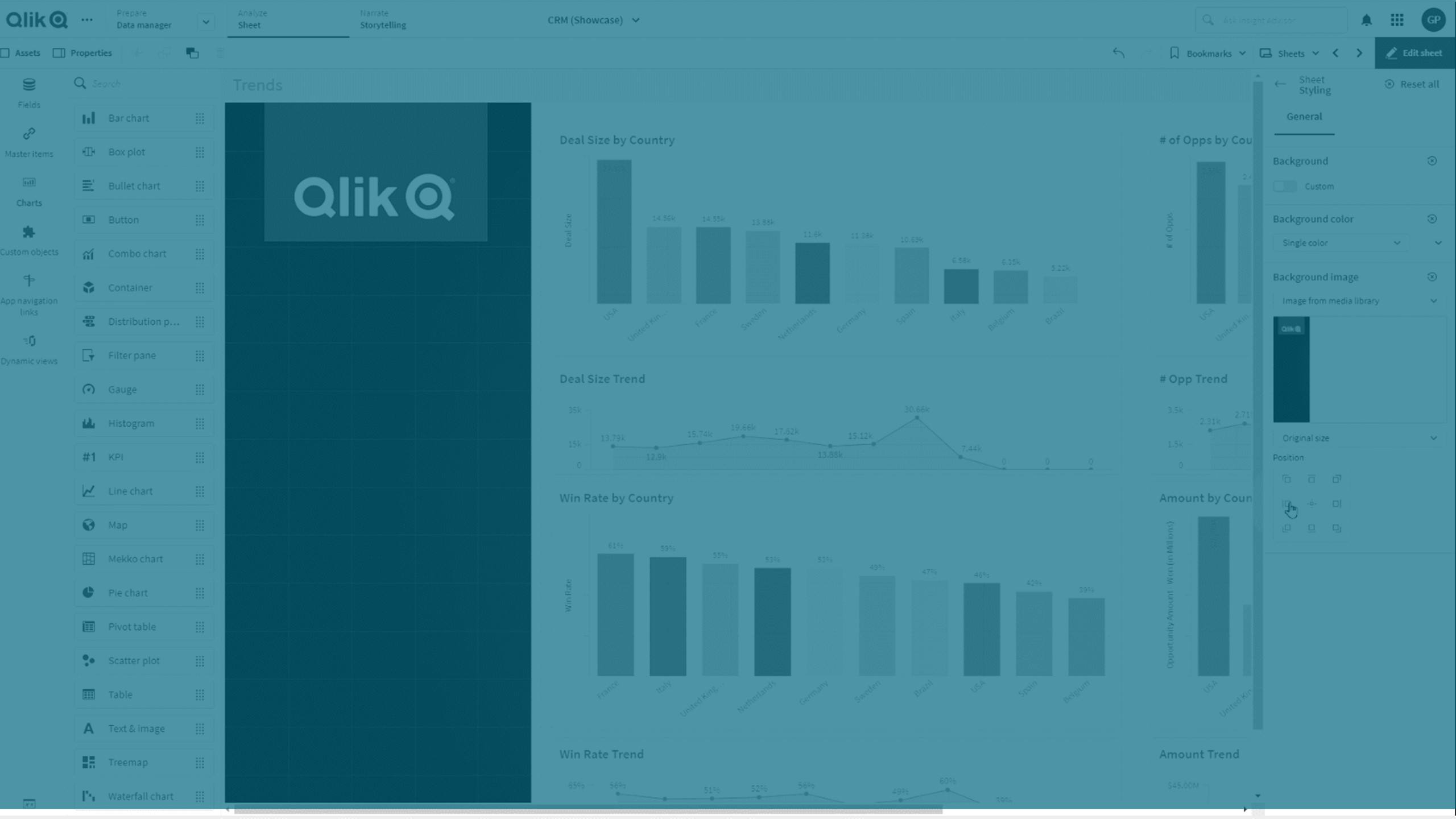
Se admiten los siguientes formatos: .png, .jpg, .jpeg y .gif. Si utiliza un .gif, puede ser animado o estático.
Qlik Cloud Government no admite imágenes de fondo ni colores en las hojas.
Haga lo siguiente:
- Abra la hoja en el modo de edición.
- En Propiedades de hoja, haga clic en Opciones de estilo.
- Establezca el Fondo en Personalizado. La opción predeterminada es Automático.
-
Color de fondo:
-
Color único: Escoja un color usando el selector de color.
-
Por expresión: Establezca un color utilizando una expresión definida por el usuario. Para más información, vea Colorear por expresión.
-
- Imagen de fondo: Seleccione Imagen de la biblioteca multimedia. El valor predeterminado es Ninguno.
-
Haga clic en
 en la reseña de imagen predeterminada.
Se abre la Biblioteca de medios.
-
Seleccione la imagen que desea utilizar y haga clic en Insertar.
Si la imagen que desea no se encuentra ya en la biblioteca multimedia, haga clic en Nueva carga y añada la imagen.
- Utilice el menú desplegable para cambiar el tamaño de su imagen:
- Tamaño original
- Ajustar siempre
- Ajustar al ancho
- Ajustar a altura
- Expandir para ajustar
- Rellenar siempre
- En Posición, puede cambiar la alineación de la imagen. Por ejemplo, la imagen se puede centrar en la hoja o en la esquina superior derecha.
La imagen y el color de fondo que seleccionó ahora están visibles en la hoja.
Hoja en modo de edición, con una imagen de fondo configurada a la izquierda
