
Last updated: 10/21/2026
The Funnel chart (Funnel chart) lets you add a sequential chart showing the connected stages of a process. Each stage will decrease and should contain a subset of the previous stage. The decrease is gradual, giving the chart an ever narrower funnel.
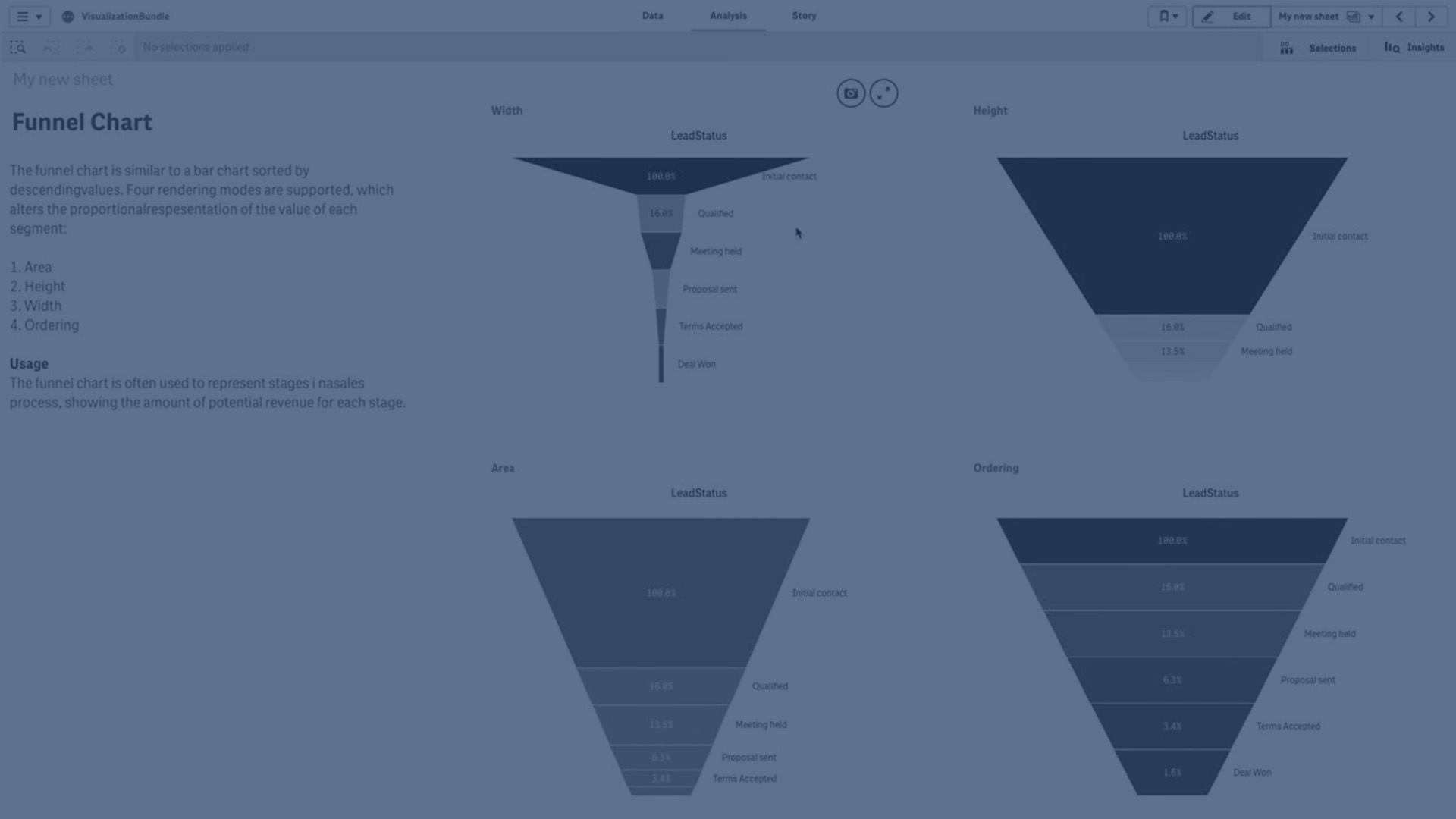
A funnel chart displaying the conversion rates of prospects to customers in a sales process.

Funnel charts show values across multiple stages in a process. They can represent anything that is decreasing in size. The funnel chart shows a process that starts at 100% and ends with a lower percentage. Each chart segment represents the value of a specific item and can influence the size of other segments.
- The chart requires one dimension and one measure.
- Unlike bar charts, funnel chart segments are centered to create a funnel shape.
- A chart with increasing stages instead of decreasing is a pyramid graph.
When to use the funnel chart
The funnel chart is useful to illustrate the stages of a process and the overall decrease of each step, for example:
- Represent a sales process showing the amount of potential revenue for each stage.
- Illustrate the number of sales prospects at each stage in a sales pipeline, i.e. the process from prospective customer to made purchase.
- Identify potential problem areas and bottlenecks of a sales process.
- Communicate a sales process to new team members and vendors.
- Illustrate website visitor trends – from visitor homepage hits to other areas, for example downloads, etc.
- Show order fulfillment with initiated orders at the top, followed by for example, orders in delivery, delivered, canceled and returned.
- Showing the flow of information from top secret to unclassified.
- Representing knowledge areas from general knowledge to expert knowledge.
Limitations
For information about general limitations, see Limitations.