
Example - Creating a PowerPoint report
Last updated: 10/9/2026In this example, you will build a PowerPoint-based report to analyze sales by year, region, and customer.
Example result

Before you start
Create a new template
Get started
Do the following:
-
Open Microsoft PowerPoint and create a new PPTX file. This will be your template file.
-
Click the Qlik add-in icon in the ribbon bar under the Home tab.
Open the Qlik add-in by clicking the Qlik icon in the ribbon bar

-
Log in to the add-in using your Qlik Cloud credentials.
Connect to the application
Do the following:
-
Select the Space where you have uploaded the application.
-
Under App, select the application.
-
Click Save.
Connecting to the uploaded application in the template
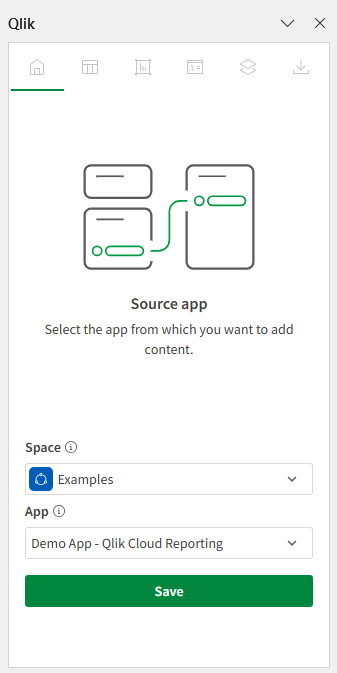
The template is now connected to the application.
Add a title slide containing a variable
On the default title slide, add some text to the title box—for example, add a title such as Sales Report.
You can add variables from the analytics application to the report. Variables store values that can change dynamically. Add a variable that has been added to the application, storing today's date. It can be added on the title slide to indicate when the report was created.
Do the following:
-
Select the description box on the title slide. This is where the variable will be inserted.
-
In the add-in, click the
 icon on the top toolbar.
The Variables and expressions section opens.
-
Click Add variable.
A list of available variables appears.
-
Click
 next to vTodayDate.
Selecting the variable to use
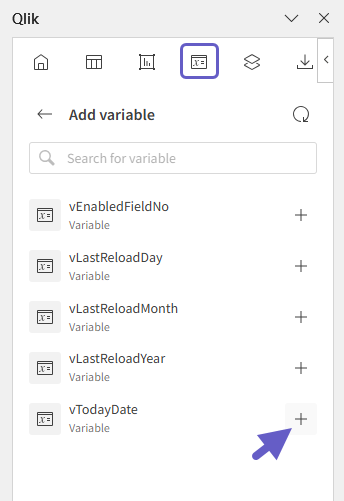
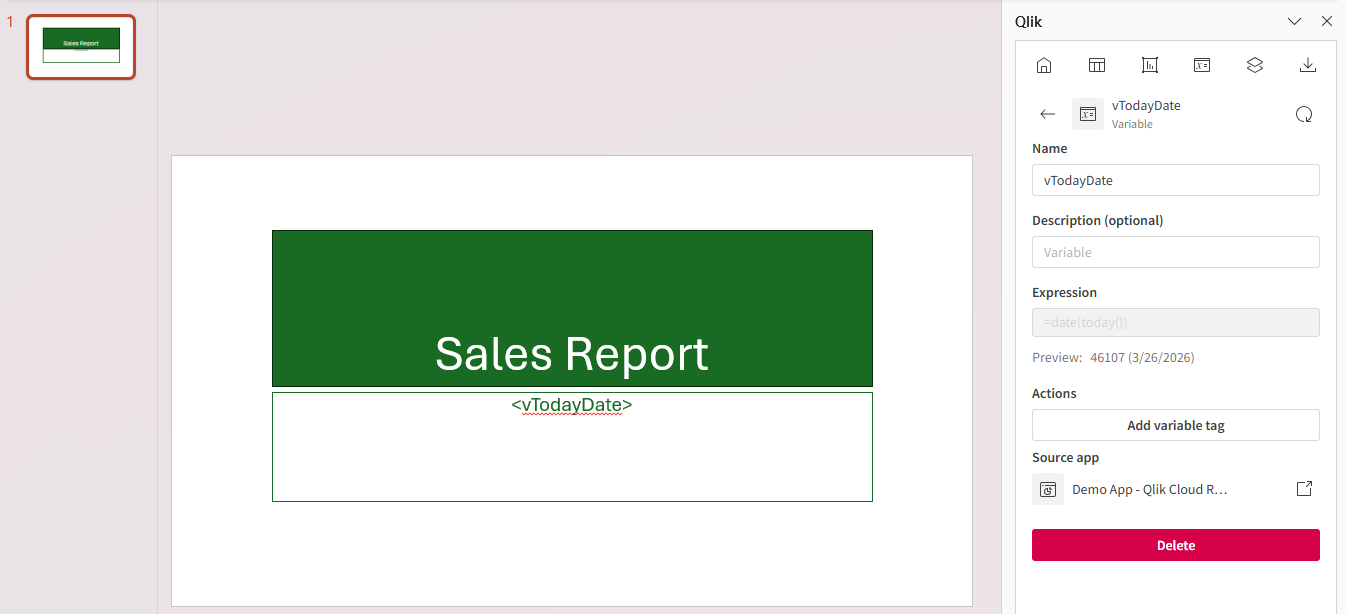
After adding the variable tag, you can style and format the title slide as desired.
Variable added to title slide
Add a page object
With page objects, you can automate the creation of filtered slides, cycling report data for each dimension value. A page creates one or more new slides for each dimension value.
Add a page object to generate a separate slide for each year.
Do the following:
-
Create a new slide.
-
In the add-in, click the
 icon on the top toolbar.
The Levels and pages section opens.
-
Click Add page.
-
Expand Fields.
-
Click
next to Date.autoCalendar.Year.Selecting the field to use for the page object

-
Under Select fields to add (optional), check the box for Date.autoCalendar.Year.
-
Click Add.
The page object is inserted and the corresponding field tag is added as the title. Note that the page tag itself is not visible as text so the field tag denotes which dimension value each slide is for.
Template with page object added

Add an expression
Next, you can add more content to the slide where the page object is inserted. All content defined by the page object will be repeated for each year value.
Add an expression to provide high-level information about total sales.
Do the following:
-
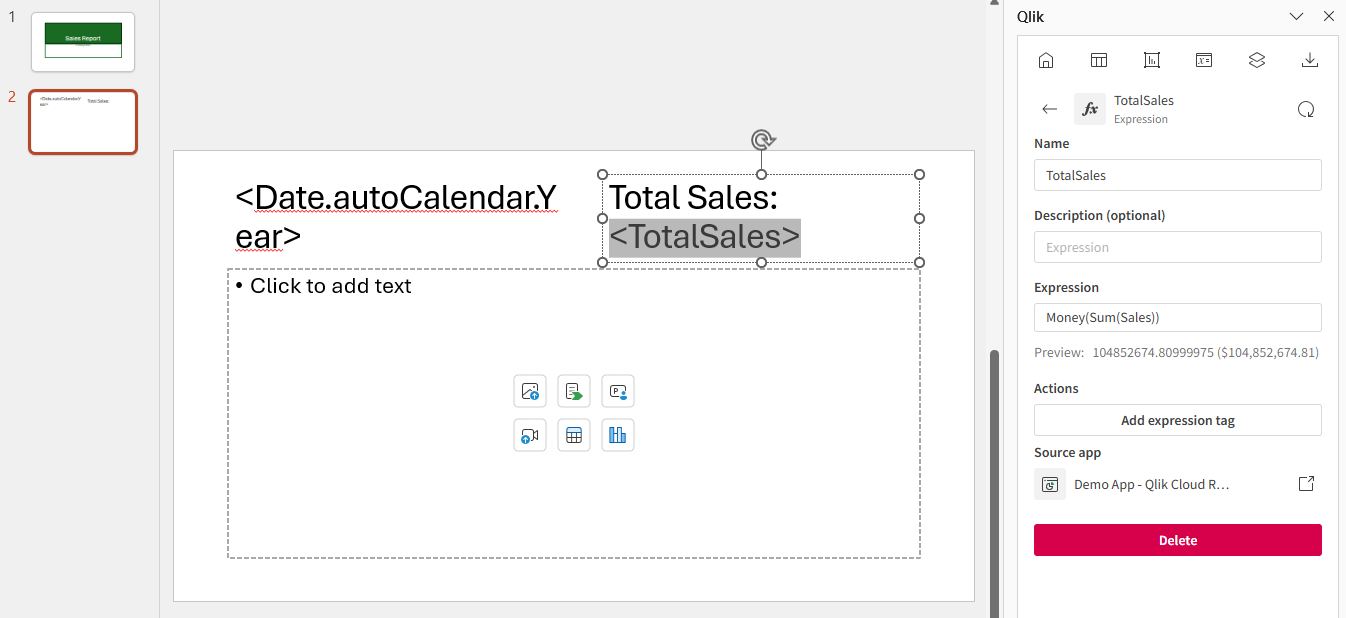
On slide 2, reduce the size of the <Date.autoCalendar.Year> title so that it occupies half of its current length.
-
Copy and paste the <Date.autoCalendar.Year> title and place the copy to the right of the original. Delete its contents.
-
With the new blank box selected, type:
Total Sales: -
In the add-in, click the
icon on the top toolbar.The Variables and expressions section opens.
-
Click Add expression.
-
Under Name, type TotalSales.
-
Under Expression, add the following:
Money(Sum(Sales)) -
Click Create.
Template with expression inserted in a title box on the slide.
Add a chart image
Do the following:
-
On slide 2, delete the content box below the title boxes.
-
In the add-in, click the
 icon on the top toolbar.
The Charts section opens.
-
Click Add chart.
A list of available sheets appears.
-
Expand the Dashboard sheet.
-
Click
next to the Top 5 Customers chart. -
Resize the chart, making it take up half of the area under the titles.
Template with chart image added.

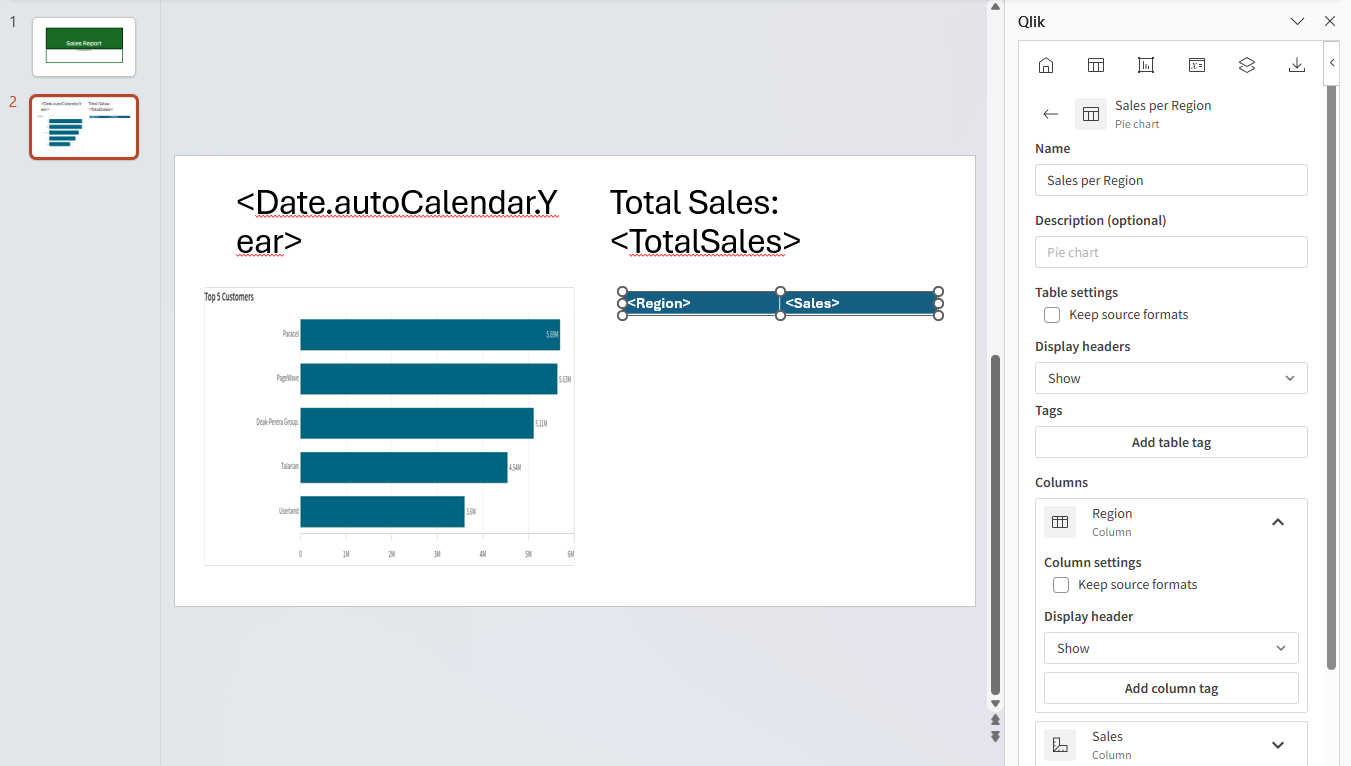
Add a table
Do the following:
-
In the add-in, click the
 icon on the top toolbar.
The Tables section opens.
-
Click Add table.
A list of available sheets appears.
-
Expand the Dashboard sheet.
-
Click
next to the Sales per Region chart, and select Individual columns. -
Under Select columns to add, check All.
-
Click Add.
All columns from the source chart are added as individual columns in a PowerPoint table.
-
Move and resize the table so it takes up the remaining space below the titles.
Template with chart image added.
Preview the report
Before finishing the report, you can set formatting and styling as desired.
When ready, preview the report as a PowerPoint file to ensure it looks as expected.
Do the following:
-
In the add-in, click the
 icon on the top toolbar.
The Preview section opens.
-
Click Preview as PowerPoint (.pptx).
Title slide in PowerPoint, containing application variable

PowerPoint report slide containing page object, chart image, expression, and table.
Next steps
The next step is to upload the template to the application.
After uploading the template, you could:
-
Configure a distribution list and report task, and set the report up to generate on a schedule.
-
Enable the template for on-demand reporting.