
Using a level to loop over app data
You can loop and repeat the creation of report elements using data from the Qlik Sense app.
For an overview of levels, see Working with levels.

High-level workflow
This is the recommended workflow for using levels in your PixelPerfect report. It covers some of the most common and simple ways to work with levels in the designer.
Part 1: Add data bindings
First, you need to add the data binding that will be used to cycle the generation of unique report elements. For example, if you want a separate section in the report for each region, you need to add a Region field as a data binding. Data bindings are added in the  Field List menu.
This workflow assumes you already have content, in the applicable areas in the template, for which you want to create a level.
Procédez comme suit :
-
Open the
Field List menu available from the right-side panel in the designer. -
Click the plus icon next to Levels.
-
Expand the sections to find the item you want to use. You can select a field from Fields, or an entire chart from any of the sheet sections.
-
Click the
 icon next to an item to add it as a data binding.
Part 2: Connect the data binding to the band
Next, you need to connect the level data binding to a band.
You cannot bind a level to the default Detail1 band, so you will need to create a new DetailReport band for content where you plan on using a level.
Procédez comme suit :
-
Create a new DetailReport band. See Creating a new band.
-
Select the new band, if not already selected.
-
Open the
 Properties menu from the right side of the designer.
 -
Under Detail Report Tasks > Data Member, select the item to use as the level.
Refreshing source data for data bindings
Vous pouvez actualiser les données d'application sources des graphiques qui ont été ajoutés sous forme de liaisons de données de niveau. Cela s'avère utile dans les cas suivants :
-
Des dimensions et des mesures ont été ajoutées au graphique source ou en ont été supprimées depuis que vous avez créé la liaison de données.
-
Les définitions de dimensions et de mesures ont été modifiées dans le graphique source depuis que vous avez créé la liaison de données.
L'actualisation des sources de liaison de données vous permet de conserver les mêmes objets dans votre menu Liste de champs sans avoir à en créer de nouveaux lorsque les configurations des graphiques changent.
Procédez comme suit :
-
Ouvrez le menu
Liste des champs disponible dans le panneau droit du concepteur. -
Double-cliquez sur Niveaux pour les développer.
-
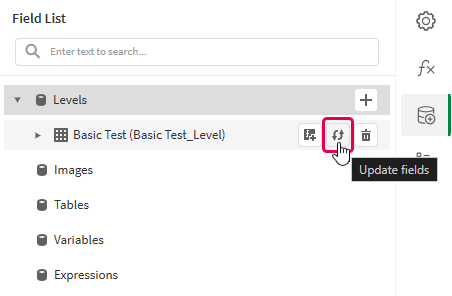
À l'aide du curseur, survolez l'élément à actualiser.
-
Cliquez sur l'icône d'actualisation (Mettre à jour les champs).
Actualisation d'une liaison de données de niveau dans le menu Liste de champs
-
Poursuivez le développement de votre modèle en fonction de votre cas d'utilisation. Cela peut impliquer la reconfiguration du contenu existant ou l'ajout de nouveau contenu. Après l'actualisation de la liaison de données, les colonnes de graphique récemment ajoutées deviennent disponibles et peuvent être utilisées dans le menu
Liste de champs.
Example - Looping chart images over a dimension
Reportez-vous aux sources d'application de l'exemple ici : Ressources contenant des exemples - Génération de rapports dans l'application. Chargez les fichiers d'application et de données dans un espace, puis actualisez l'application. Vous êtes prêt à suivre l'exemple.
Part 1: Add data bindings
Procédez comme suit :
-
Create a new PixelPerfect template.
-
Open the
Field List in the designer.Field List menu in the PixelPerfect designer

-
Click the plus icon next to Levels.
-
Expand Fields, and click the
icon next to the Region chart.The data binding is added.
-
You are brought back to the main
Field List menu. Click the plus icon next to Images. -
Expand the Dashboard sheet, and click the
icon next to the Top 5 Customers chart.The data binding is added.
Field List menu showing newly created level and image data bindings

Part 2: Add band and content
Procédez comme suit :
-
On the design surface, right-click the Detail1 band and select Insert Band > DetailReport.
-
Open the
Field List menu, and double-click Levels to expand it. -
For Region, expand the level object and drag the Region field within it onto the DetailReport1 band.
Position the label at the top of the band.
-
In the
Field List menu, expand Images and drag Top 5 Customers onto the DetailReport1 band. Place it below the Region label.
You can customize and style the content as desired.
Part 3: Bind the level to the band
Procédez comme suit :
-
Click the DetailReport1 band.
-
Open the
Properties menu from the right side of the designer. -
Under Detail Report Tasks > Data Member, select the Region field.
Report template with content and DetailReport1 band bound to level

-
In the top right corner, click Save template.
-
Click Preview report. Download the report and open it.
Report preview
