
Configuring experiments
上次更新日期:2026/10/9The configuration of experiments consists of selecting the target and the features that the model will use to predict the target. You can also configure a number of optional settings.
To support you in the selection of a target, the historical dataset is analyzed and summary statistics are displayed about each column in the dataset. Several automatic preprocessing steps are applied to the dataset to make sure that only suitable data is included. For more details on the data preprocessing, see 自动数据准备和转换.
After running v1, you can create new experiment versions if needed to further refine the model training. For more information, see 微调模型.
Requirements and permissions
To learn more about the user requirements for working with ML experiments, see 使用实验.
The interface
The following sections outline how to navigate the experiment interface to configure your experiment. For more information about the interface, see 导航实验界面.
Tabbed navigation
When you create an experiment, the Configuration tab opens. This is where you can configure the target and features for the experiment.
After running at least one experiment version, the Configuration tab becomes Training data. Other tabs also become available. These other tabs allow you to analyze the models you have just trained in the version. If you need to configure subsequent versions with different feature selections, you can return to the Training data tab.
Schema view and Data view
In the Configuration/Training data tab, you can alternate between  Schema view and
  Data view.
Schema view
Schema view is the default view. In this view, each column in your dataset is represented by a row in the schema with information and statistics.
You can:
-
Select features to include in your experiment.
-
View details about each column, such as data type and feature type.
-
View insights about columns, such as why they cannot be selected, or how they will be processed during training.
 to customize the information in the table. For example, you can hide certain columns to reduce the information that is displayed.
Schema view in an ML experiment

Data view
Data view is an alternative view you can use to access more information and sample data for each column.
Data view in an ML experiment

Experiment configuration panel
In the experiment configuration panel, you can further customize the experiment training. This panel is open by default in new experiments.
After running a version, click  View configuration to open the panel to configure the next version.
With the experiment configuration panel, you can:
-
选择目标和实验类型
-
设置版本名称
-
添加或删除特性
-
配置实验的新版本
-
查看您正在训练的模型类型
-
选择更改或刷新训练数据集
-
添加或删除算法
-
更改模型优化设置
-
对于时间序列模型,设置预测设置
-
配置偏差检测
实验配置面板
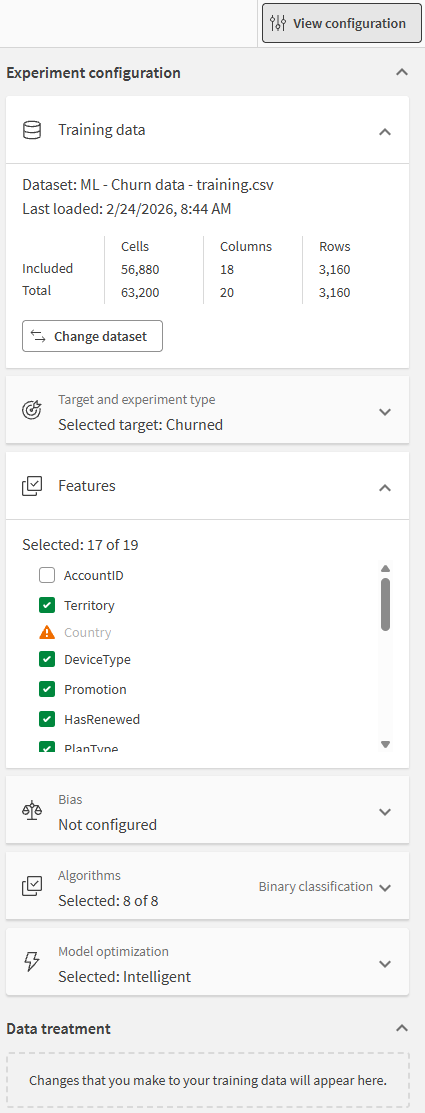
Selecting the target and experiment type
You can change the target column and experiment type until you start the first training. After that, they are locked for editing.
The target column contains the values that you want the machine learning model to predict.
The experiment type is determined by the target and the type of data it contains. The experiment type defines what type of model you want to train. The following options may be available:
-
Binary classification: Trains models to predict a target that has two possible values (for example, yes or no). Data can be of any feature type.
-
Multiclass classification: Trains models to predict a target with 3-10 possible values (for example, a list of categories). Data can be of any feature type but a column with more than 10 distinct, non-numeric classes (values) is not selectable as the target.
-
Regression: Trains models to predict a target with more than 10 possible values — specifically, a target with numeric feature type.
-
Time series: Trains models to forecast target values for specific future time periods, leveraging historical data. The target must have more than 10 distinct values and have numeric data. For more information, see 使用时间序列实验.
执行以下操作:
-
In
Schema view or Data view, click the radio button for a column.The target column is now indicated by
 and the other available columns are automatically selected as features.
Selecting the target in Schema view

In the experiment configuration panel, under Experiment settings, you can change the target before training if needed.
When the target and experiment type are selected, you can start running the first version of the experiment. Read more in 训练实验. You can do additional configuration at this point—described below—or adjust the configuration after you have reviewed the training results.
Explanations of how your data is being interpreted and processed are shown as the experiment training continues. For more information, see 解释数据集洞察.
Selecting feature columns
With the target set, you can choose which of the other available columns to include in the training of the model. Exclude any features that you don't want to be part of the model. Note that the column will stay in the dataset but will not be used by the training algorithm.
At the top of the experiment configuration panel, you can see the number of cells in your dataset. If the number exceeds your dataset limit, you can exclude features to get below the limit.
You can select the feature columns in various ways:
In Schema view and Data view
In the main views, you can:
-
Deselect Include all available features and then select only the ones you want to include.
-
Manually clear the checkboxes for the features you don't want to include.
-
Make a search and exclude or include all features in your filtered search result.
In these views, each column has an icon next to it to provide more information:
-
 : The feature is included, or can be included, in the experiment.
 -
 : The feature is excluded from the experiment. It can sometimes be included, but is generally not recommended.
 -
 : The feature cannot be included in the experiment.
In the experiment configuration panel
In the experiment configuration panel, you can:
-
Manually clear the checkboxes for the features you don't want to include.
-
After you have run the first version of the experiment, you can define the Number of top features to include.
Features section in the experiment configuration panel
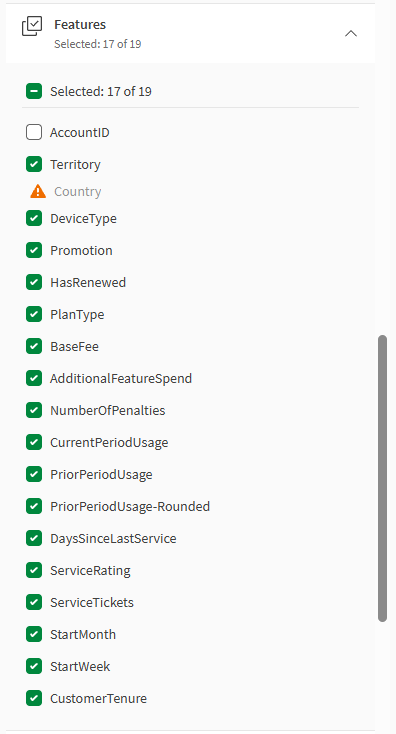
When you select features, they are automatically assigned a feature type. The possible feature types are:
-
Categorical
-
Numeric
-
Date
-
Free text
The feature type is assigned based on the data contained in the feature column. If a feature meets certain criteria, it might be selected to become the basis for auto-engineered features. If desired, you can change whether the feature is used for automatic feature engineering. For full details about automatic feature engineering, see 自动特性工程.
Certain columns in your dataset may not be selectable as features for your experiment, or may have specific processing applied to them. Explanations of how your data is being interpreted and processed are shown as you navigate experiment training. For more information, see 解释数据集洞察.
Configuring bias detection
You can activate bias detection for features containing sensitive data. Bias detection is performed when you run the experiment. You can also click Get recommendations to use generative AI to scan your training data for possibly sensitive features before running bias detection.
Bias detection determines whether the feature increases the model's likelihood of promoting unfair outcomes in its predictions, or if the source data is inherently biased.
执行以下操作:
-
在机器学习实验中,在训练配置面板中展开偏差。
-
在选择用于偏差检测的特性之前,(可选)单击获取建议以使用生成式 AI 建议可能包含偏差数据的特性。请参阅使用生成式 AI 推荐用于偏差检测的功能。
-
选择或取消选择您要对其运行偏差检测的任何特性。
或者,在架构视图中为所需功能开启偏差检测。
For more information about bias detection, see 检测机器学习模型中的偏差.
Selecting algorithms
All available algorithms are included by default and you can exclude any algorithms that you don't want to use. Normally, you would do this as part of the model refinement when you have seen the first training results. Read more in 微调模型.
Algorithms section in the experiment configuration panel

Changing feature types
When a dataset is loaded, the columns are treated as categorical, numeric, date, or free text based on the data type and other characteristics. In some cases, you might want to change this setting.
For example, if the days of the week are represented by the numbers 1-7, each number represents a categorical value. By default, it is treated as a continuous ranked numeric value, so you would need to manually change the configuration to treat it as categorical.
When a column is identified as containing date and time information, it is used as the basis for new generated auto-engineered features. When this happens, the original column (the parent feature) is treated as having the date feature type.
You can change the parent feature from a date feature to a categorical or numeric feature. For example, this is useful when a feature is identified as a date, but you need it to be treated as a string or number. When you do this, you can no longer use its auto-engineered features in experiment training.
执行以下操作:
-
In
Schema view, locate the feature. -
In the Feature type column for this feature, click
 .
. -
Select a value in the list.
You can alternatively change feature types from Data view. Locate the feature, then click next to the current feature type. Select a value in the list.
Time series forecasting
If you are training a time series experiment, certain feature type transformations are automatically applied depending on your configuration. For example, if you select any groups to use for multivariate forecasting, the feature types of these groups are automatically switched to categorical.
Impact on predictions
当您手动更改特性的特性类型,然后部署生成的模型时,特性类型覆盖项将应用于应用数据集中的特性,该数据集用于使用该模型进行的预测。
Changing dataset
You can change the training dataset before you run the first experiment version, as well as after running any version.
If you change the dataset before running the first version, you will lose any configuration that you have done prior to changing the dataset.
执行以下操作:
-
In the experiment configuration panel under Training data > Review dataset, click Change dataset.
-
Select a new dataset.
For more information about changing and refreshing the dataset during model refinement (after running an experiment version), see 更改和刷新数据集.
Configuring model optimization
If your experiment type is binary classification, multiclass classification, or regression, you can adjust the following settings to optimize your models:
-
Turning intelligent model optimization on or off
-
Turning hyperparameter optimization on or off
-
Turning time-aware training on or off
These options can be turned on or off for each version of the experiment that you run.
Model optimization section in the experiment configuration panel
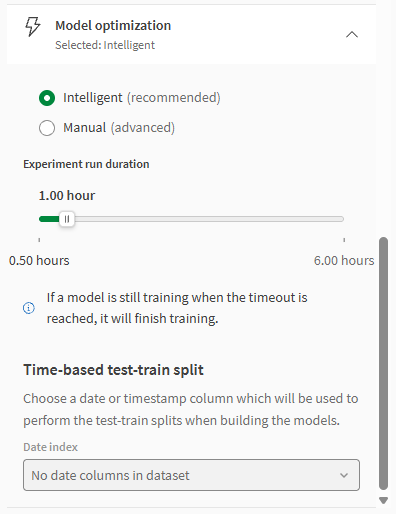
Configuring intelligent optimization
By default, the experiment uses intelligent model optimization. With intelligent model optimization, Qlik Predict handles the model refinement process for you by iterating feature selection and applying advanced transformations to your data.
For more information about intelligent optimization, see 智能模型优化.
You can turn this setting off to manually refine the models you train. For example, you might want to start your model training with intelligent model optimization, then switch to manual refinement for v2 to further adjust the configuration.
执行以下操作:
-
Click
View configuration. -
If you have already run at least one version of the experiment, click New version.
-
In the panel, expand Model optimization.
-
Switch from Intelligent to Manual.
-
Using the slider, set the maximum run duration for the training.
Configuring hyperparameter optimization
You can optimize the models using hyperparameter optimization. Note that this is an advanced option that could increase the training time significantly. Hyperparameter optimization is available if you turn off intelligent optimization.
For more information, see 超参数优化.
执行以下操作:
-
Click
View configuration. -
If you have already run at least one version of the experiment, click New version.
-
In the panel, expand Model optimization.
-
Switch from Intelligent to Manual.
-
Select the Hyperparameter optimization checkbox.
-
Optionally, set a time limit for your optimization. The default time limit is one hour.
Configuring time-aware training
If you want your models trained with consideration to a time series dimension, activate time-aware training for the experiment version. To use this option, you need to have a column in your dataset that contains the relevant time series information.
When time-aware training is turned on, Qlik Predict uses specialized cross-validation and null imputation processes to train the models.
For more information, see 创建时间感知模型 and 基于时间的交叉验证.
执行以下操作:
-
Click
View configuration. -
If you have already run at least one version of the experiment, click New version.
-
In the panel, expand Model optimization.
-
Under Time-based test-train split, select the Date index to use for sorting the data.
Viewing insights about the training data
In the Configuration/Training data tab of the experiment, you can view insights into the handling of the training data. This information is available in the Insights column in Schema view. The information shown depends on whether or not you have run a version with the current training data. The changes in the Insights column can help you identify why features might be unavailable for use, or why they have been automatically dropped.
For more information about what each insight means, see 解释数据集洞察.