
Pepperjam (v1)
Last updated: 9/15/2026Pepperjam is currently in beta. The info in this guide is subject to change.
This integration is powered by Singer's Pepperjam tap. For support, visit the GitHub repo or join the Singer Slack.
Pepperjam integration summary
Stitch’s Pepperjam integration replicates data using the Pepperjam Advertiser API v20120402. Refer to the Schema section for a list of objects available for replication.
Pepperjam feature snapshot
A high-level look at Stitch's Pepperjam (v1) integration, including release status, useful links, and the features supported in Stitch.
| STITCH | |||
| Release status |
Beta |
Supported by
|
|
|
Stitch plan
|
Standard |
API availability
|
Available
|
| Singer GitHub repository | |||
| REPLICATION SETTINGS | |||
|
Anchor Scheduling
|
Supported
|
Advanced Scheduling
|
Supported
|
|
Table-level reset
|
Unsupported
|
Configurable Replication Methods
|
Unsupported
|
| DATA SELECTION | |||
|
Table selection
|
Supported
|
Column selection
|
Supported
|
|
Select all
|
Supported
|
||
| TRANSPARENCY | |||
|
Extraction Logs
|
Supported
|
Loading Reports
|
Supported
|
Connecting Pepperjam
Step 1: Obtain your API key
- Login to your Pepperjam account.
- In the Developer Kit menu, click API Keys.
- Click Generate New Key.
- Your API key will display.
Keep this page open - you’ll need it to complete the next step.
Step 2: Add Pepperjam as a Stitch data source
- Sign into your Stitch account.
-
On the Stitch Dashboard page, click the Add Integration button.
-
Click the Pepperjam icon.
-
Enter a name for the integration. This is the name that will display on the Stitch Dashboard for the integration; it’ll also be used to create the schema in your destination.
For example, the name “Stitch Pepperjam” would create a schema called
stitch_pepperjamin the destination. Note: Schema names cannot be changed after you save the integration. - In the API Key field, paste the API key you obtained in step 1.
Step 3: Define the historical replication start date
The Sync Historical Data setting defines the starting date for your Pepperjam integration. This means that data equal to or newer than this date will be replicated to your data warehouse.
Change this setting if you want to replicate data beyond Pepperjam’s default setting of 1 year. For a detailed look at historical replication jobs, check out the Syncing Historical SaaS Data guide.
Step 4: Create a replication schedule
In the Replication Frequency section, you’ll create the integration’s replication schedule. An integration’s replication schedule determines how often Stitch runs a replication job, and the time that job begins.
Pepperjam integrations support the following replication scheduling methods:
-
Advanced Scheduling using Cron (Advanced or Premium plans only)
To keep your row usage low, consider setting the integration to replicate less frequently. See the Understanding and Reducing Your Row Usage guide for tips on reducing your usage.
Step 5: Set objects to replicate
The last step is to select the tables and columns you want to replicate. Learn about the available tables for this integration.
Note: If a replication job is currently in progress, new selections won’t be used until the next job starts.
For Pepperjam integrations, you can select:
-
Individual tables and columns
-
All tables and columns
Click the tabs to view instructions for each selection method.
- In the integration’s Tables to Replicate tab, locate a table you want to replicate.
-
To track a table, click the checkbox next to the table’s name. A blue checkmark means the table is set to replicate.
-
To track a column, click the checkbox next to the column’s name. A blue checkmark means the column is set to replicate.
- Repeat this process for all the tables and columns you want to replicate.
- When finished, click the Finalize Your Selections button at the bottom of the screen to save your selections.
- Click into the integration from the Stitch Dashboard page.
-
Click the Tables to Replicate tab.
- In the list of tables, click the box next to the Table Names column.
-
In the menu that displays, click Track all Tables and Fields:
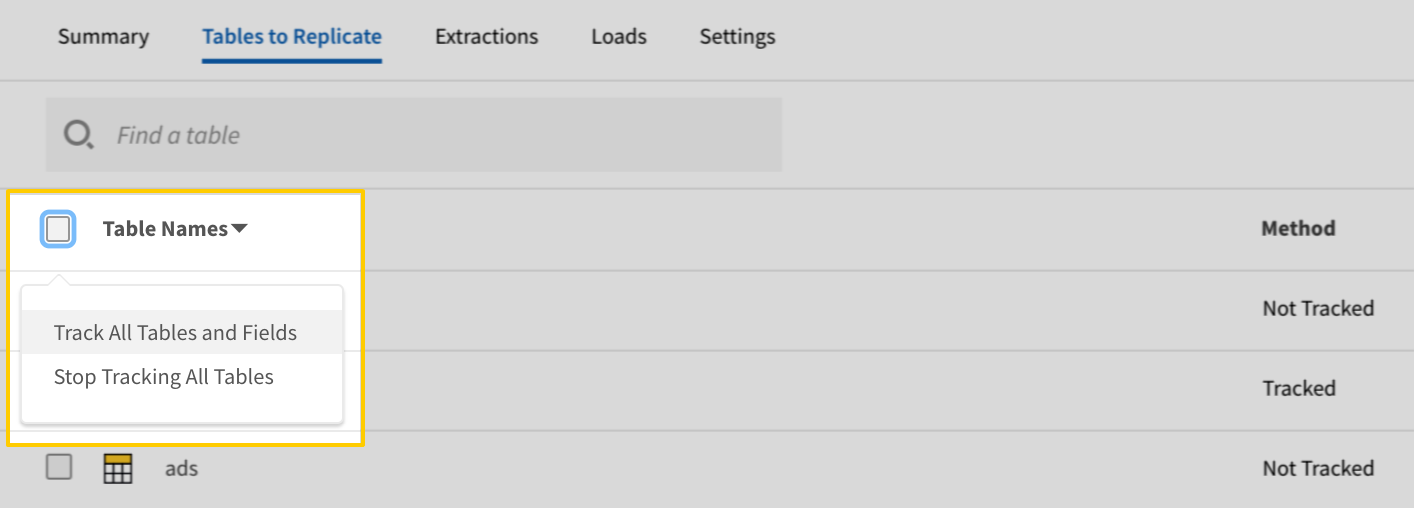
The Track all Tables and Fields menu in the Tables to Replicate tab - Click the Finalize Your Selections button at the bottom of the page to save your data selections.
Initial and historical replication jobs
After you finish setting up Pepperjam, its Sync Status may show as Pending on either the Stitch Dashboard or in the Integration Details page.
For a new integration, a Pending status indicates that Stitch is in the process of scheduling the initial replication job for the integration. This may take some time to complete.
Initial replication jobs with Anchor Scheduling
If using Anchor Scheduling, an initial replication job may not kick off immediately. This depends on the selected Replication Frequency and Anchor Time. Refer to the Anchor Scheduling documentation for more information.
Free historical data loads
The first seven days of replication, beginning when data is first replicated, are free. Rows replicated from the new integration during this time won’t count towards your quota. Stitch offers this as a way of testing new integrations, measuring usage, and ensuring historical data volumes don’t quickly consume your quota.
Pepperjam replication
Attribution windows and data extraction
Every time Stitch runs a replication job for Pepperjam, the last 28-30 days’ worth of data will be replicated for the following tables:
Stitch replicates data in this way to account for updates made to existing records within an attribution window, thus ensuring you won’t make decisions based on stale (or false) data. As a result, you may see a higher number of replicated rows than what’s being generated in Pepperjam.
Setting the Replication Frequency to a higher frequency - like 30 minutes - can result in re-replicating recent data and contribute to greater row usage. Replicating fewer tables or selecting a lower frequency can help keep your row count low.
In the sections below are examples of how attribution windows impact how Stitch extracts data during historical and ongoing replication jobs.
For historical and full re-replications of Pepperjam data, Stitch will query for and extract data newer than or equal to the date defined in the Start Date field in the Integration Settings page.
The Start Date, in conjunction with the Attribution Window, defines the minimum date Stitch should query for when extracting historical data. This is calculated as:
Start Date - Attribution Window = Minimum Extraction Date
Example
During the initial set up, the Start Date field is set to July 3, 2017, or 2017-07-03 00:00:00.
To account for the Attribution Window, Stitch would calculate the Minimum Extraction Date value as: 2017-07-03 00:00:00 - 28-30 days = 2017-06-03 00:00:00
If you were to write a SQL query using this date for the transaction_details table, it might look like this:
  SELECT *
    FROM pepperjam.transaction_details
   WHERE sale_date >= '2017-06-03 00:00:00'   /* Min. Extraction Date */
ORDER BY sale_date
For ongoing replication jobs, Stitch will query for and extract data using the last saved maximum value in the table’s Replication Key column and the Attribution Window for the table.
Note: This applies to every replication job that takes place after the historical replication job.
Example
The last maximum saved Replication Key value for the transaction_details table is 2017-10-01 00:00:00.
To account for the Attribution Window of 28-30 days, we’d subtract this from the last maximum saved Replication Key value:
2017-10-01 00:00:00 - 28-30 days = 2017-09-01 00:00:00
In this case, Stitch would query for and extract data that is newer than or equal to 2017-09-01 00:00:00 and older than or equal to 2017-10-01 00:00:00.
If this were a SQL query, it might look like this:
  SELECT *
    FROM transaction_details
   WHERE sale_date >= '2017-09-01 00:00:00'
                              /* max Replication Key value - Attribution Window */
     AND sale_date <= '2017-10-01 00:00:00'
                              /* max Replication Key value from previous job */
ORDER BY sale_date
Pepperjam table reference
Schemas and versioning
Schemas and naming conventions can change from version to version, so we recommend verifying your integration’s version before continuing.
The schema and info displayed below is for version 1 of this integration.
This is the latest version of the Pepperjam integration.
Table and column names in your destination
Depending on your destination, table and column names may not appear as they are outlined below.
For example: Object names are lowercased in Redshift (CusTomERs > customers), while case is maintained in PostgreSQL destinations (CusTomERs > CusTomERs). Refer to the Loading Guide for your destination for more info.
creative_advanced
The creative_advanced table contains information about advanced link creatives in your Pepperjam account.
|
Key-based Incremental |
|
|
Primary Key |
id |
|
Replication Key |
modified |
| Useful links |


creative_banner
The creative_banner table contains information about banner creatives in your Pepperjam account.
|
Key-based Incremental |
|
|
Primary Key |
id |
|
Replication Key |
modified |
| Useful links |
creative_coupon
The creative_coupon table contains information about coupon creatives in your Pepperjam account.
|
Key-based Incremental |
|
|
Primary Key |
id |
|
Replication Key |
modified |
| Useful links |
creative_generic
The creative_generic table contains information about generic link creatives in your Pepperjam account.
|
Key-based Incremental |
|
|
Primary Key |
type |
|
Replication Key |
modified |
| Useful links |
creative_performance
The creative_performance table contains information about your Pepperjam creatives’ performance within a -day time frame from the date of the last table replication.
Note: During every replication job, Stitch will replicate the last days’ worth of data for this table. Refer to the Attribution windows and data extraction section for more info.
|
Key-based Incremental |
|
|
Primary Keys |
creative_id creative_type date |
|
Replication Key |
datetime |
| Useful links |
creative_performance_by_publisher
The creative_performance_by_publisher table contains information about your Pepperjam creatives’ performance, per publisher, within a -day time frame from the date of the last table replication.
Note: During every replication job, Stitch will replicate the last days’ worth of data for this table. Refer to the Attribution windows and data extraction section for more info.
|
Key-based Incremental |
|
|
Primary Keys |
creative_id creative_type date publisher_id |
|
Replication Key |
datetime |
| Useful links |
creative_product
The creative_product table contains information about product creatives in your Pepperjam account.
|
Full Table |
|
|
Primary Key |
id |
| Useful links |
creative_promotion
The creative_promotion table contains information about promotion creatives in your Pepperjam name account.
|
Full Table |
|
|
Primary Key |
id |
| Useful links |
creative_text
The creative_text table contains information about text creatives in your Pepperjam account.
|
Key-based Incremental |
|
|
Primary Key |
id |
|
Replication Key |
modified |
| Useful links |
group
The group table contains information about groups in your Pepperjam account.
|
Full Table |
|
|
Primary Key |
id |
| Useful links |
group_member
The group_member table contains information about members within groups in your Pepperjam account.
|
Full Table |
|
|
Primary Key |
id |
| Useful links |
itemized_list
The itemized_list table contains information about your itemized lists in your Pepperjam account.
|
Full Table |
|
|
Primary Key |
id |
| Useful links |
itemized_list_product
The itemized_list_product table contains information about products within your itemized lists in your Pepperjam account.
|
Full Table |
|
|
Primary Key |
id |
| Useful links |
publisher
The publisher table contains information about the publishers, the publishers’ status, and the publishers’ term in your Pepperjam account.
|
Full Table |
|
|
Primary Key |
id |
| Useful links |
publisher_performance
The publisher_performance table contains information about publishers’ performance within a -day time frame from the date of the last table replication.
Note: During every replication job, Stitch will replicate the last days’ worth of data for this table. Refer to the Attribution windows and data extraction section for more info.
|
Key-based Incremental |
|
|
Primary Keys |
date publisher_id |
|
Replication Key |
datetime |
| Useful links |
term
The term table contains information about the terms for your program in your Pepperjam account.
|
Full Table |
|
|
Primary Key |
id |
| Useful links |
transaction_details
The transaction_details table contains all publisher transaction details, within a -day time frame from the date of the last table replication.
Note: During every replication job, Stitch will replicate the last days’ worth of data for this table. Refer to the Attribution windows and data extraction section for more info.
|
Key-based Incremental |
|
|
Primary Key |
transaction_id |
|
Replication Key |
sale_date |
| Useful links |
transaction_history
The transaction_history table contains all historical publisher transactions, within a -day time frame from the date of the last table replication.
Note: During every replication job, Stitch will replicate the last days’ worth of data for this table.
|
Key-based Incremental |
|
|
Primary Keys |
transaction_id process_date sale_date |
|
Replication Key |
sale_date |
| Useful links |