
Zendesk Support (v2)
Last updated: 9/15/2026This integration is powered by Singer's Zendesk Support tap and certified by Stitch. Check out and contribute to the repo on GitHub.
For support, contact Support.
Zendesk Support integration summary
Stitch’s Zendesk Support integration replicates data using the Zendesk Support API. Refer to the Schema section for a list of objects available for replication.
Zendesk Support feature snapshot
A high-level look at Stitch's Zendesk Support (v2) integration, including release status, useful links, and the features supported in Stitch.
| STITCH | |||
| Release status |
Released on May 24, 2023 |
Supported by
|
|
|
Stitch plan
|
Standard |
API availability
|
Available
|
| Singer GitHub repository | |||
| REPLICATION SETTINGS | |||
|
Anchor Scheduling
|
Supported
|
Advanced Scheduling
|
Supported
|
|
Table-level reset
|
Unsupported
|
Configurable Replication Methods
|
Unsupported
|
| DATA SELECTION | |||
|
Table selection
|
Supported
|
Column selection
|
Supported
|
|
Select all
|
Supported
|
||
| TRANSPARENCY | |||
|
Extraction Logs
|
Supported
|
Loading Reports
|
Supported
|
Connecting Zendesk Support
Zendesk Support setup requirements
To set up Zendesk Support in Stitch, you need:
-
Administrator permissions in Zendesk Support. Some data types in Zendesk Support may only be accessed with Admin permissions. For example: To replicate ticket metric or tag data, Zendesk Support’s API requires a user with Admin permissions.
To ensure you can replicate all the data you need, we recommend a user with Admin permissions set up the integration.
-
A specific Zendesk Support plan if replicating ticket forms or SLA policies:
- To replicate SLA policies, you must be on an Enterprise or Professional Zendesk Support plan.
- To replicate ticket forms, you must be on an Enterprise Zendesk Support plan, or a Professional Zendesk Support plan with the ticket forms add-on.
All other tables, with the exception of
sla_policiesandticket_formswill be available for replication even if you aren’t on either of these Zendesk Support plans.
Step 1: Add Zendesk Support as a Stitch data source
- Sign into your Stitch account.
-
On the Stitch Dashboard page, click the Add Integration button.
-
Click the Zendesk Support icon.
-
Enter a name for the integration. This is the name that will display on the Stitch Dashboard for the integration; it’ll also be used to create the schema in your destination.
For example, the name “Stitch Zendesk Support” would create a schema called
stitch_zendesk_supportin the destination. Note: Schema names cannot be changed after you save the integration. - In the Zendesk Subdomain field, enter your Zendesk Support site prefix. For example: For
stitchdata.zendesk.com, onlystitchdatawould be entered into this field.
Step 2: Define the historical replication start date
The Sync Historical Data setting defines the starting date for your Zendesk Support integration. This means that data equal to or newer than this date will be replicated to your data warehouse.
Change this setting if you want to replicate data beyond Zendesk Support’s default setting of 1 year. For a detailed look at historical replication jobs, check out the Syncing Historical SaaS Data guide.
Step 3: Create a replication schedule
In the Replication Frequency section, you’ll create the integration’s replication schedule. An integration’s replication schedule determines how often Stitch runs a replication job, and the time that job begins.
Zendesk Support integrations support the following replication scheduling methods:
-
Advanced Scheduling using Cron (Advanced or Premium plans only)
To keep your row usage low, consider setting the integration to replicate less frequently. See the Understanding and Reducing Your Row Usage guide for tips on reducing your usage.
Step 4: Authorize Stitch to access Zendesk Support
- Next, you’ll be prompted to sign into your Zendesk Support account.
- After the authorization process is successfully completed, you’ll be directed back to Stitch.
- Click All Done.
Step 5: Set objects to replicate
The last step is to select the tables and columns you want to replicate. Learn about the available tables for this integration.
Note: If a replication job is currently in progress, new selections won’t be used until the next job starts.
For Zendesk Support integrations, you can select:
-
Individual tables and columns
-
All tables and columns
Click the tabs to view instructions for each selection method.
- In the integration’s Tables to Replicate tab, locate a table you want to replicate.
-
To track a table, click the checkbox next to the table’s name. A blue checkmark means the table is set to replicate.
-
To track a column, click the checkbox next to the column’s name. A blue checkmark means the column is set to replicate.
- Repeat this process for all the tables and columns you want to replicate.
- When finished, click the Finalize Your Selections button at the bottom of the screen to save your selections.
- Click into the integration from the Stitch Dashboard page.
-
Click the Tables to Replicate tab.
- In the list of tables, click the box next to the Table Names column.
-
In the menu that displays, click Track all Tables and Fields:
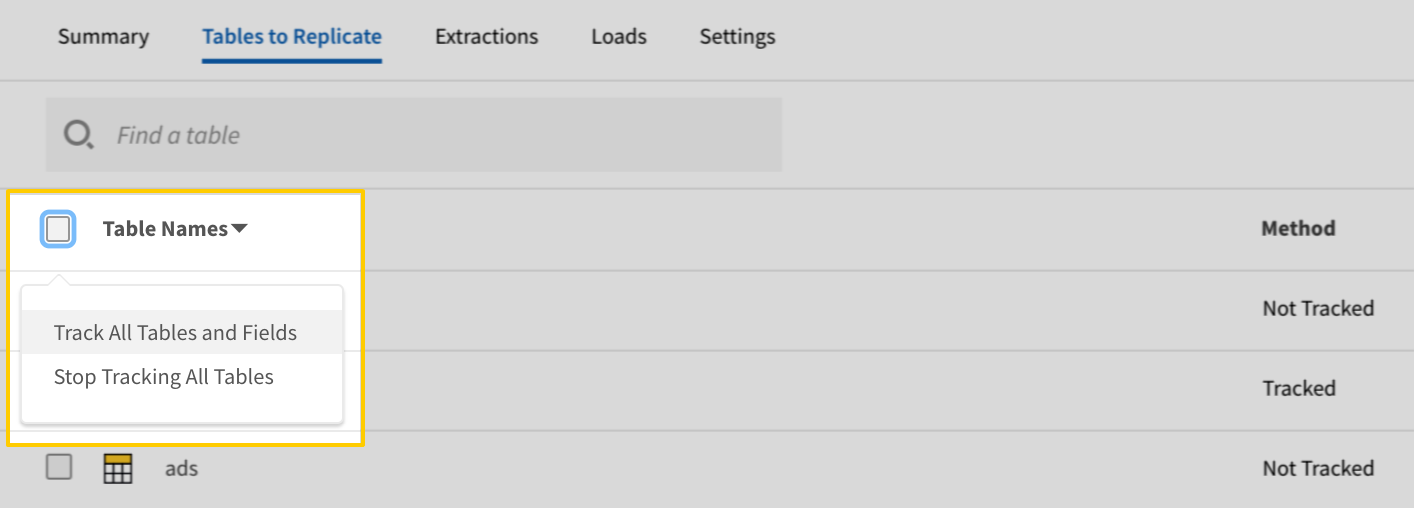
The Track all Tables and Fields menu in the Tables to Replicate tab - Click the Finalize Your Selections button at the bottom of the page to save your data selections.
Initial and historical replication jobs
After you finish setting up Zendesk Support, its Sync Status may show as Pending on either the Stitch Dashboard or in the Integration Details page.
For a new integration, a Pending status indicates that Stitch is in the process of scheduling the initial replication job for the integration. This may take some time to complete.
Initial replication jobs with Anchor Scheduling
If using Anchor Scheduling, an initial replication job may not kick off immediately. This depends on the selected Replication Frequency and Anchor Time. Refer to the Anchor Scheduling documentation for more information.
Free historical data loads
The first seven days of replication, beginning when data is first replicated, are free. Rows replicated from the new integration during this time won’t count towards your quota. Stitch offers this as a way of testing new integrations, measuring usage, and ensuring historical data volumes don’t quickly consume your quota.
Zendesk Support replication
Replicating SLA policies and ticket forms
To replicate SLA policies and ticket forms - or the sla_policies and ticket_forms tables - you need to be on an Enterprise or Professional Zendesk Support plan. To replicate ticket_forms on a Professional plan, you’ll also need to have the ticket forms add-on enabled in your Zendesk Support account.
If you set either table to replicate and don’t meet the requirements listed above, an error similar to the following will surface in the integration’s Extraction Logs:
tap - INFO replicated 0 records from "ticket_forms" endpoint
tap - CRITICAL {"error": {"message": "You do not have access to this page. Please contact the account owner of this help desk for further help.", "title": "Forbidden"}}
To resolve the error, de-select the appropriate table(s). Reach out to Zendesk if you have questions about your Zendesk plan.
Replicating user and organization custom fields
To replicate custom fields for Users and Organizations - or the users and organizations tables - you need to be on an Enterprise, Professional, or Team Zendesk plan.
If you set custom fields in the users or organizations tables to replicate and don’t meet the requirements listed above, an error similar to the following will surface in the integration’s Extraction Logs:
tap - WARNING The account credentials supplied do not have access to `organizations` custom fields.
tap - WARNING The account credentials supplied do not have access to `users` custom fields.
To resolve the error, de-select the appropriate field(s). Reach out to Zendesk if you have questions about your Zendesk plan.
Zendesk Support table reference
Schemas and versioning
Schemas and naming conventions can change from version to version, so we recommend verifying your integration’s version before continuing.
The schema and info displayed below is for version 2 of this integration.
This is the latest version of the Zendesk Support integration.
Table and column names in your destination
Depending on your destination, table and column names may not appear as they are outlined below.
For example: Object names are lowercased in Redshift (CusTomERs > customers), while case is maintained in PostgreSQL destinations (CusTomERs > CusTomERs). Refer to the Loading Guide for your destination for more info.
group_memberships
The group_memberships table contains info about the groups your Zendesk Support agents are members of.
Note: Retrieving group membership data requires Zendesk Support Agent or Admin permissions.
Deleted group memberships
As Zendesk Support’s API doesn’t currently provide a method for identifying deleted group memberships, we recommend periodically dropping this table and allowing Stitch to re-create it. Currently, dropping and re-populating the table is the only way to detect deletions.
|
Key-based Incremental |
|
|
Primary Key |
id |
|
Replication Key |
updated_at |
| Useful links |


groups
The groups table contains info about the groups in your Zendesk Support account.
Note: Retrieving group data requires Zendesk Support Admin or Agent permissions.
|
Key-based Incremental |
|
|
Primary Key |
id |
|
Replication Key |
updated_at |
| Useful links |
macros
The macros table contains info about the macros in your Zendesk Support account. Macros are actions defined by you that modify the values of a ticket’s fields.
Note: Retrieving macro data requires Zendesk Support Agent or Admin permissions.
|
Key-based Incremental |
|
|
Primary Key |
id |
|
Replication Key |
updated_at |
| Useful links |
organizations
The organizations table contains information about the organizations your end-users belong to.
Custom organization fields
Stitch’s Zendesk Support integration will replicate any custom fields associated with organization records.
Note: Replicating organization custom fields requires that you be on a Team, Professional, or Enterprise Zendesk Support plan and have Admin permissions in Zendesk Support.
|
Key-based Incremental |
|
|
Primary Key |
id |
|
Replication Key |
updated_at |
| Useful links |
satisfaction_ratings
The satisfaction_ratings table contains info about ratings users have offered on support tickets.
Note: This table is only available if satisfaction ratings are enabled in your Zendesk Support account.
|
Key-based Incremental |
|
|
Primary Key |
id |
|
Replication Key |
updated_at |
| Useful links |
sla_policies
The sla_policies table contains info about the Service Level Agreements (SLAs) in your Zendesk Support account. An SLA is a documented agreement between a support provider and their customers that defines performance measures for support.
Note: Replicating SLA policies requires that you be on an Enterprise or Professional Zendesk Support plan, and have Admin permissions in Zendesk Support.
|
Full Table |
|
|
Primary Key |
id |
| Useful links |
tags
The tags table contains the names and total number of applications of tags in your Zendesk Support account. Only the 20,000 most popular tags used in the last 60 days are extracted.
Note: Retrieving tag data requires Zendesk Support Admin permissions.
|
Full Table |
|
|
Primary Key |
name |
| Useful links |
talk_phone_numbers
This table contains data about phone numbers in Zendesk Talk.
|
Full Table |
|
|
Primary Key |
id |
| Useful links |
ticket_audits
The ticket_audits table contains info about the activity associated with a ticket. An audit is a history of all updates to a given ticket. When a ticket is updated in Zendesk Support, an audit record is created. Each audit represents a single update to a ticket.
A single audit record may include multiple event types. For example: A ticket comment, satisfaction rating, and a change event. For a full list of Zendesk Support audit event types, refer to Zendesk Support’s documentation.
Replication
This table uses Append-Only Incremental Replication. This means that new audit records, or updates made to existing audits, are appended as new rows to the end of the table.
|
Append-Only Incremental |
|
|
Primary Key |
id |
|
Replication Key |
created_at |
| Useful links |
ticket_comments
The ticket_comments table contains info about the comments on tickets, which is the conversation between requesters, collaborators, and agents. Comments can be public or private.
|
Key-based Incremental |
|
|
Primary Key |
id |
|
Replication Key |
created_at |
| Useful links |
ticket_fields
The ticket_fields table contains info about the basic text and custom ticket fields in your Zendesk Support account.
Note: Retrieving ticket metric data requires Zendesk Support Agent or Admin permissions.
|
Key-based Incremental |
|
|
Primary Key |
id |
|
Replication Key |
updated_at |
| Useful links |
ticket_forms
The ticket_forms table contains info about the ticket forms in your Zendesk Support account.
Note: Replicating ticket forms requires that you be on an Enterprise Zendesk Support plan or a Professional plan with the corresponding add-on, and have Admin permissions in Zendesk Support.
|
Key-based Incremental |
|
|
Primary Key |
id |
|
Replication Key |
updated_at |
| Useful links |
ticket_metric_events
This table contains data about reply times, agent work times, and requester wait times.
|
Key-based Incremental |
|
|
Primary Key |
id |
|
Replication Key |
time |
| Useful links |
ticket_metrics
The ticket_metrics table contains info about the metrics associated with Zendesk Support tickets. This table will not include records for deleted tickets.
Note: Retrieving ticket metric data requires Zendesk Support Admin permissions.
Deleted ticket metrics
As Zendesk Support’s API doesn’t currently support returning metrics for deleted tickets, this table will not contain any metrics for deleted tickets.
If you believe you’re missing records, check in your Zendesk Support account to see if the missing records are for deleted tickets.
For more info on how Zendesk Support handles deleting tickets, refer to their documentation.
|
Key-based Incremental |
|
|
Primary Key |
id |
|
Replication Key |
updated_at |
| Useful links |
tickets
The tickets table contains info about the tickets in your Zendesk Support account. Tickets are the means through which your end users (customers) communicate with your Zendesk Support agents.
Note: Retrieving ticket data requires Zendesk Support Admin permissions.
Custom ticket fields
Stitch’s Zendesk Support integration will replicate all custom ticket fields.
|
Key-based Incremental |
|
|
Primary Key |
id |
|
Replication Key |
generated_timestamp |
| Useful links |
users
The users table contains info about the users associated with your Zendesk Support account. This includes agents, admins, and end-users (customers).
Note: Retrieving user data requires Zendesk Support Admin permissions.
Custom user fields
Stitch’s Zendesk Support integration will replicate any custom fields associated with user records.
Note: Replicating user custom fields requires that you be on a Team, Professional, or Enterprise Zendesk Support plan.
|
Key-based Incremental |
|
|
Primary Key |
id |
|
Replication Key |
updated_at |
| Useful links |