
Using a level to loop over app data
You can loop and repeat the creation of report elements using data from the Qlik Sense app.
For an overview of levels, see Working with levels.

High-level workflow
This is the recommended workflow for using levels in your PixelPerfect report. It covers some of the most common and simple ways to work with levels in the designer.
Part 1: Add data bindings
First, you need to add the data binding that will be used to cycle the generation of unique report elements. For example, if you want a separate section in the report for each region, you need to add a Region field as a data binding. Data bindings are added in the  Field List menu.
This workflow assumes you already have content, in the applicable areas in the template, for which you want to create a level.
Gehen Sie folgendermaßen vor:
-
Open the
Field List menu available from the right-side panel in the designer. -
Click the plus icon next to Levels.
-
Expand the sections to find the item you want to use. You can select a field from Fields, or an entire chart from any of the sheet sections.
-
Click the
 icon next to an item to add it as a data binding.
Part 2: Connect the data binding to the band
Next, you need to connect the level data binding to a band.
You cannot bind a level to the default Detail1 band, so you will need to create a new DetailReport band for content where you plan on using a level.
Gehen Sie folgendermaßen vor:
-
Create a new DetailReport band. See Creating a new band.
-
Select the new band, if not already selected.
-
Open the
 Properties menu from the right side of the designer.
 -
Under Detail Report Tasks > Data Member, select the item to use as the level.
Refreshing source data for data bindings
Sie können die Daten der Quell-App aktualisieren, die für als Ebenendatenbindungen hinzugefügte Diagramme verwendet wurden. Dies ist in folgenden Situationen hilfreich:
-
Dimensionen und Kennzahlen wurden dem Quelldiagramm hinzugefügt oder daraus entfernt, seit Sie die Datenbindung erstellt haben.
-
Die Definitionen von Dimensionen und Kennzahlen wurden im Quelldiagramm geändert, seit Sie die Datenbindung erstellt haben.
Durch das Aktualisieren von Datenbindungsquellen können Sie dieselben Objekte in Ihrem Menü Feldliste beibehalten und brauchen keine neuen Objekte zu erstellen, wenn sich Diagrammkonfigurationen ändern.
Gehen Sie folgendermaßen vor:
-
Öffnen Sie das Menü
Feldliste, das Sie auf der rechten Seite des Designers finden. -
Doppelklicken Sie auf Ebenen, um sie zu erweitern.
-
Bewegen Sie den Mauszeiger über das Element, das Sie aktualisieren möchten.
-
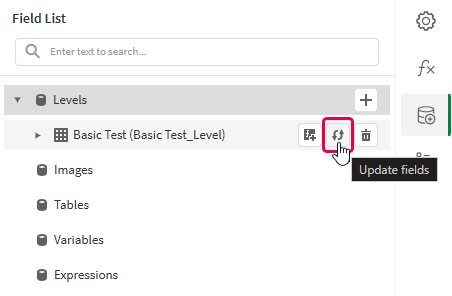
Klicken Sie auf das Symbol „Aktualisieren“ (Felder aktualisieren).
Aktualisieren der Datenbindung einer Ebene im Menü Feldliste
-
Fahren Sie mit der Entwicklung der Vorlage entsprechend Ihrem Anwendungsfall fort. Dazu kann gehören, dass Sie bestehende Inhalte neu konfigurieren oder neue Inhalte hinzufügen. Nach dem Aktualisieren der Datenbindung stehen die neu hinzugefügten Diagrammspalten nun im Menü
Feldliste zur Verfügung.
Example - Looping chart images over a dimension
Sehen Sie sich die Quellen der Beispiel-App hier an: Beispielmaterialien – In-App-Berichte. Laden Sie die App und die Datendateien in einen Bereich hoch und laden Sie dann die App neu. Sie sind bereit, das Beispiel fertigzustellen.
Part 1: Add data bindings
Gehen Sie folgendermaßen vor:
-
Create a new PixelPerfect template.
-
Open the
Field List in the designer.Field List menu in the PixelPerfect designer

-
Click the plus icon next to Levels.
-
Expand Fields, and click the
icon next to the Region chart.The data binding is added.
-
You are brought back to the main
Field List menu. Click the plus icon next to Images. -
Expand the Dashboard sheet, and click the
icon next to the Top 5 Customers chart.The data binding is added.
Field List menu showing newly created level and image data bindings

Part 2: Add band and content
Gehen Sie folgendermaßen vor:
-
On the design surface, right-click the Detail1 band and select Insert Band > DetailReport.
-
Open the
Field List menu, and double-click Levels to expand it. -
For Region, expand the level object and drag the Region field within it onto the DetailReport1 band.
Position the label at the top of the band.
-
In the
Field List menu, expand Images and drag Top 5 Customers onto the DetailReport1 band. Place it below the Region label.
You can customize and style the content as desired.
Part 3: Bind the level to the band
Gehen Sie folgendermaßen vor:
-
Click the DetailReport1 band.
-
Open the
Properties menu from the right side of the designer. -
Under Detail Report Tasks > Data Member, select the Region field.
Report template with content and DetailReport1 band bound to level

-
In the top right corner, click Save template.
-
Click Preview report. Download the report and open it.
Report preview
