
Adding sparklines
A sparkline is a simple visualization, usually styled in the form of a line, that is helpful for analyzing trends for a single metric. You can add sparklines to your PixelPerfect report using the Sparkline object.
A sparkline generally consists of a field (equivalent to a dimension) and a value member (equivalent to a measure).

Sparkline

Requirements
The data you use for a sparkline has to be added as a table data binding. These data bindings are added under Tables in the  Field List menu.
The source data for the sparkline should ideally contain a single dimension and a single measure. To use sparklines to visualize more complex, multi-dimensional data, it is recommended that you apply a level to the band where you add the sparkline. In this case, the level should be an additional dimension along which you want to cycle the generation of multiple filtered sparklines.
Creating sparklines
This is the recommended workflow for adding sparklines in your report.
Procedere come indicato di seguito:
-
Open the
Field List menu available from the right-side panel in the designer. -
Click the plus icon next to Tables.
-
From the available sheets, select the Qlik Sense chart you want to add as a table. Click the
 icon next to it.
The data binding is added.
-
From the toolbox panel on the left side of the designer, drag a Sparkline onto the design surface.
-
Click the gear icon that appears next to the sparkline. In the pop-up menu, for Data Member, select the table data binding you created earlier.
-
Open the
 Properties menu from the right side of the designer, and expand Data.
 -
For Value Member, select the variable metric you want to visualize (for example, sales).
Refreshing source data for data bindings
Nel corso del tempo, la configurazione del grafico di origine potrebbe cambiare, richiedendo un'azione nel modello del report PixelPerfect. È possibile aggiornare i dati dell'app di origine nelle associazioni dati che definiscono il grafico sparkline. Questo tipo di grafico è utile per:
-
Le dimensioni e le misure sono state aggiunte o rimosse dal grafico di origine dalla creazione dell'associazione dati.
-
Le definizioni di dimensioni e misure sono state modificate nel grafico di origine dalla creazione dell'associazione dati.
L'aggiornamento delle sorgenti delle associazioni dati consente di mantenere gli stessi oggetti nel menu Elenco campi, senza doverne creare di nuovi quando le configurazioni del grafico cambiano.
Procedere come indicato di seguito:
-
Aprire il menu Elenco campi
, disponibile nel pannello laterale destro dello strumento di progettazione. -
Fare doppio clic su Tabelle per espandere l'opzione.
-
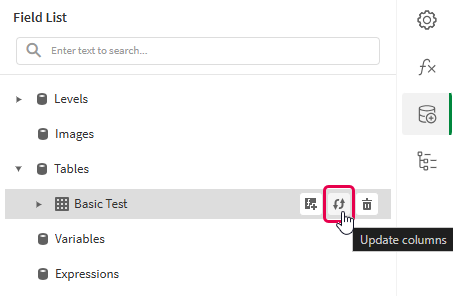
Posizionare il cursore sull'elemento che si desidera aggiornare.
-
Fare clic sull'icona Aggiorna (Aggiorna colonne).
Aggiornamento dell'associazione dati di una tabella nel menu Elenco campi
-
Continuare a sviluppare il modello in base al proprio caso d'uso. Ciò può comportare la riconfigurazione dei contenuti esistenti o l'aggiunta di nuovi contenuti. Dopo aver aggiornato l'associazione dati, le colonne del grafico appena aggiunte saranno ora disponibili per l'uso nel menu
Elenco campi.
Example - Sparklines with a level
Fare riferimento alle sorgenti delle app di esempio qui: Materiali di esempio: report in app. Caricare i file di app e dati in uno spazio, quindi ricaricare l'app; quindi, è possibile completare l'esempio.
We will create sparklines with monthly sales by region.
Part 1: Add data bindings
Procedere come indicato di seguito:
-
Create a new PixelPerfect template.
-
Open the
Field List menu available from the right-side panel in the designer.Field List menu in the PixelPerfect designer

-
Click the plus icon next to Levels.
-
Expand Fields, and click the
icon next to Region.The data binding is added.
-
You are brought back to the main
Field List menu. Click the plus icon next to Tables. -
Expand the Sales Table sheet, and click the
icon next to the Regional Sales over Time chart.The data binding is added.
Part 2: Add DetailReport band and connect it with data banding
You need to create a DetailReport band to use a level.
Procedere come indicato di seguito:
-
Right-click the Detail1 band, and then click Insert Band > DetailReport.
-
To bind the DetailReport1 band to the level, select the band and then open the
Properties menu. Under Detail Report Tasks > Data Member, select the Region level.
Part 3: Add a label and sparkline
Procedere come indicato di seguito:
-
Open the
Field List menu, and double-click Levels to expand it. -
For Region, expand the level object and drag the Region field within it onto the DetailReport1 band.
Position the label at the top of the band, centered horizontally.
-
From the toolbox panel on the left side of the designer, drag a Sparkline onto the DetailReport1 band, below the Region label.
-
Resize the sparkline so that it occupies all horizontal space on the band, and its shape is a narrow rectangle.
-
Resize the DetailReport1 band so there is a small space at the bottom of the sparkline.
Region label and empty sparkline added to template

-
Select the sparkline and then open the
Properties menu. -
Expand Appearance > View.
-
Check Highlight Max Point and Highlight Min Point.
-
For Color, expand the drop down menu. Paste the following hex code in the # field: 0d00ff. Click OK.
-
For Max Point Color, expand the drop down menu. Paste the following hex code in the # field: 0dff00. Click OK.
-
For Min Point Color, expand the drop down menu. Paste the following hex code in the # field: ff0000. Click OK.
-
In the top right corner, click Save template.
-
Click Preview report. Download the report and open it.
Report preview with sparklines
