
Managing licenses
Last updated: 10/15/2026From the license page in Talend Administration Center, an administrator can:
- check the parameters of the licenses and add new licenses. For more information, see Adding one or more licenses.
- validate the license. For more information, see Generating a validation request.
- validate a renewed license manually when automatic reactivation does not complete. For more information, see How to validate a license after renewal.
In the Menu tree view, click Licenses to display the license parameters for the Administration Center. The parameters displayed may vary depending on your license.
The Available users area shows the number of users created in the current active licenses, as well as the sum of users allowed in these active licenses.
The Stored license keys area shows all licenses and their parameters. If the Show inactive option is not selected, only the active licenses are displayed in the area.
The All active license runtime details area shows the number of CPU cores allowed by the licenses for ESB servers, the actual number of CPU cores used by all active ESB servers, and the number of active ESB servers.
The runtime details include:
- Licensed cores: total number of the licensed cores (number of servers allowed by the license x 4)
-
Used Cores: total number of the used cores (server1 cores,
server2 cores, server3 cores, server4 cores, server5 cores)
- the maximum number of server cores shown in the brackets is 5.
- If there are more than 5 active servers, they are shown as (server1 cores, server2 cores, server3 cores, server4 cores, ..., serverLast cores). If you point your mouse over this field, a tooltip will be shown where all server cores are listed.
- ? means the server status is inactive or shut down.
- Used Servers: number of the active ESB servers
For example, the two rows in the following table show the ESB licenses currently used. The licenses currently used are duplicated in this table. If ESB licenses have two rows in the table, it means that the information about the number of used cores and used servers is duplicated. In this example, the number of production and non-production used cores is 8(8,?,?) and the number of used servers is 3.
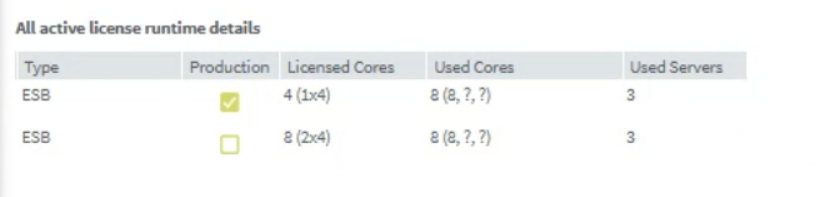
You must sum up all the used cores from each of your production and non-production licenses and compare them to the licensed cores, in this example you can compare the 8 (8,?,?) used cores with (4+8) licensed cores.

The license parameters provide the following information:
|
Field/Tab |
Description |
|---|---|
|
License mode |
Concurrent users: This mode allows you to create as many users as necessary. However, only defined number of users are authorized to use Talend Studio and / or Talend Administration Center simultaneously. Named users: This mode allows you to create a limited number of users authorized to connect to Talend Studio and / or Talend Administration Center. This authorization is based on the user's login. For the above two license modes, a user is not allowed to connect simultaneously to two instances of Talend Studio and/or Talend Administration Center, but the user can simultaneously access both. Mixed license: This mode allows you to combine concurrent and named users. You get a maximum number of defined users and a maximum number of connected users. On the Users page, in the Count Policy field, you define for each user if it is a named or concurrent user. Information noteNote: In case of a crash of Talend Studio or of Talend Administration Center, your connection will be retained when you restart the
application.
|
|
Data Integration/ESB |
Indicates the number of created users out of the maximum number of users authorized to work on Data Integration or ESB projects. |
|
Data Management |
Indicates the number of created users out of the maximum number of users authorized to work on Data Management projects. |
|
ESB Runtime |
Indicates the number of ESB Talend Runtime instances authorized. |
|
Data Preparation |
Indicates the number of created users out of the maximum number of users authorized to work on Data Preparation projects. This license type only includes Named users. |
|
Data Stewardship |
Indicates the number of created users out of the maximum number of users authorized to work on Data Stewardship projects. This license type only includes Named users. |
|
Admin User |
Indicates the number of created users out of the maximum number of users authorized to perform Administrative operations. This license type includes both Named and Concurrent users. |
|
Product |
Name of the Talend product. |
|
Version |
Version of the Talend product. |
|
Expiration |
License expiration date. |
|
Expires in (days) |
Number of days left before the license expires. |
|
Runtime |
Number of runtime servers allowed in the license. The Open button allows you to display the details (instances number and type, to be used in Production or not, etc.) of the runtime servers allowed for the selected license. Note that if you add several licenses that contain runtime servers, the sum of these runtime servers is displayed in the All active runtime details area. |
|
Talend Cloud |
Indicates whether Talend Cloud is included in the license. |
|
Active |
Status of the license. It can be either active ( |
 ) or inactive (
 ).
).Regularly all products counted strictly: 1 User Type + Role assignment = 1 unit in license with the corresponding type. But there are some exceptions from the rules:
| License Type | Product | Not counted | Counted in license / login |
|---|---|---|---|
| Concurrent / Named | Talend Administration Center (TAC) | NPA + Security Administrator / Viewer | All other types |
Also Talend Data Fabric license have the Administrative Use role hat includes rights for Security Administrator and Administrator.
If your license is not or no longer valid, you can always access the Users page and remove or disable a user account, such as when you have changed the license and your new license allows fewer users than the old one.