
Rozszerzenia i adnotacje Talend
Ostatnia aktualizacja: 30.09.2026Eksportuj swoje API z rozszerzeniami lub adnotacjami Talend, aby zachować wyrazistość zapewnianą przez API Designer.
Podczas eksportowania API możesz zdecydować się na dołączenie rozszerzeń Talend dla specyfikacji OpenAPI lub adnotacji Talend dla RAML. Pozwalają one zachować strukturę API zdefiniowaną w API Designer.
Na przykład w Contacts API zasoby i operacje są posortowane na sekcje, a bloki tekstu służą do dodawania informacji.
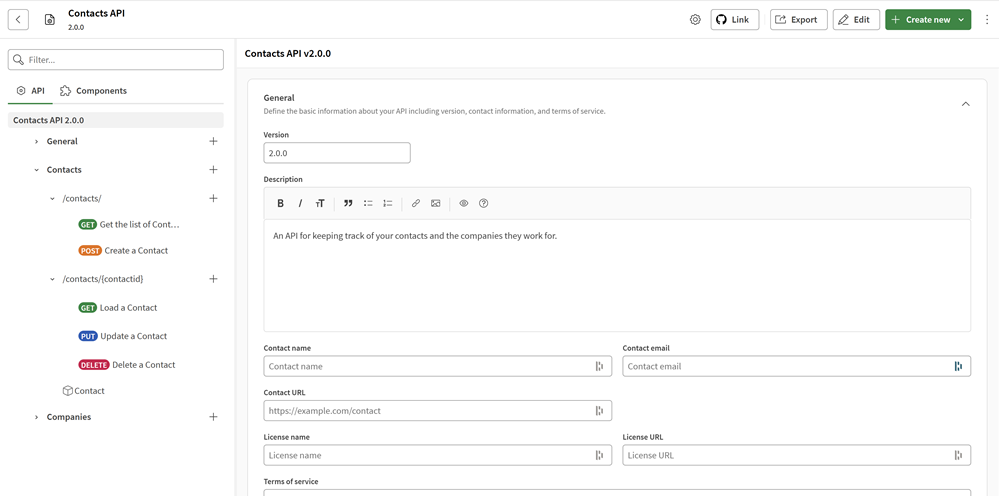
Jeśli wyeksportujesz tę definicję bez rozszerzeń lub adnotacji Talend, sekcje i bloki tekstu nie zostaną wyeksportowane. Jednak w przypadku rozszerzeń lub adnotacji są one uwzględniane w kodzie.
Informacje o sekcji są dodawane do każdego elementu zawartego w sekcji:
    x-talend:
      section: "Companies"
Bloki tekstu są dodawane na końcu pliku:
  texts:
    3a36b8ba-2969-46f0-a36e-9d715eeece36:
      title: "Authentication"
      content: "This API is secured using Basic Authentication.\n\nAll **read operations are open** and don't require authentication. However, all **write operations require authentication**. "
      section: "General"
    612e4b7f-0530-4835-8a47-f580869c67df:
      title: "Error handling"
      content: "This API uses standard HTTP status codes to indicate the status of a response.\n\nThere are two main categories of error responses. Each have a different response payload structure.\n\n* Simple errors\n* Detailed errors\n\n\n# Simple errors\n\n| Name | Code | Description |\n| -------- | -------- | -------- |\n| Bad request     | 400     | The request was unacceptable     |\n| Unauthorized     | 401     | The request has not been applied because it lacks valid authentication credentials for the target resource.     |\n| Forbidden     | 403     | The server understood the request, but is refusing to fulfill it     |\n| Not Found     | 404     | The server has not found anything matching the request URI     |\n| Not acceptable     | 406     | The server is unable to return a response in the format that was requested by the client     |\n| Unsupported Media Type     | 415     | The server is refusing to service the request because the entity of the request is in a format not supported by the requested resource for the requested method     |\n| Too many requests     | 429     | Too many requests hit the API too quickly     |\n| Server error     | 500     | A technical error occured  |\n\n\n\n\n\n\n# Detailed errors\n| Name | Code | Description |\n| -------- | -------- | -------- |\n| Unprocessable entity     | 422     | The server understands the content type of the request entity, and the syntax of the request entity is correct, but was unable to process the contained instructions.     |\n\n\n\n\n"
| Server error     | 500     | A technical error occurred  |\n\n\n\n\n\n\n# Detailed errors\n| Name | Code | Description |\n| -------- | -------- | -------- |\n| Unprocessable entity     | 422     | The server understands the content type of the request entity, and the syntax of the request entity is correct, but was unable to process the contained instructions.     |\n\n\n\n\n"
      section: "General"