
Generative AI with Qlik Answers®
What is Qlik Answers ?
Qlik Answers is a plug-and-play, generative AI-powered knowledge assistant that provides business users with personalized, contextually relevant answers to questions sourced from structured and unstructured content. Unlike traditional search, generative AI delivers personalized answers to questions instead of just lists of content.
Unstructured responses are derived from a number of underlying sources and documents that have been carefully curated into domain-specific knowledge bases. You just ask it a question and get an answer – it’s that simple. Answers are reliable and consistent, and with full explainability, you’ll always know where things came from and have access to those sources – ensuring consistency, trust and transparency.
Structured responses come from your own Qlik Applications allowing you to leverage your investment in Analytics for much wider audiences. Qlik Answers can leverage your existing content and create new content as it fully understands the business logic in your applications.
Why Qlik Answers ?
The opportunity
Qlik has long been a leader in structured analytics and data integration. However not all data in organizations is structured data. According to Forester, 80% of the worlds data is unstructured and 70% of enterprises agree they are not effectively leveraging the value in this data. Search engines have been seen as a way to leverage this data; however they provide limited benefits in this space as they are really only doing pattern matches and often return irrelevant results.
Gen-AI (generative artificial intelligence) has grown massively over the last year as a solution for unstructured data. Gen-AI's ability to answer natural language questions and create content based on existing knowledge provides solutions such as virtual assistants, code generation, and process optimization. When used in an Enterprise context, Gen-AI helps provide value from that 80% of unstructured data.
The challenges
The barrier to entry for Gen-AI is considerable. While LLMs (large language models) receive a lot of attention, the reality is this is just one of many technologies needed to implement a Gen-AI solution. The cost and complexity to do this well is beyond the resources of all but the largest organizations. This necessitates most organizations using a third-party solution. In most cases this involves storing the organization's data with that third-party and risks questions being answered not just with an organization's own data, but with other publicly available data which may be outdated or inaccurate. Also, many of these solutions are subject to hallucinations, where content is made up by the Gen-AI solution. These solutions typically lack the governance and security that organizations come to expect around their data and raise the risk of legal issues, reputational issues, or both.
The solution
These factors are why we have developed our Gen-AI solution, Qlik Answers. Qlik Answers is an Enterprise-grade, plug-and-play, generative AI-powered knowledge assistant that provides business users with personalized, contextually relevant answers to questions sourced from Structured and unstructured content. Running on the Qlik Cloud platform, Qlik Answers leverages Qlik Cloud's existing security and governance features to provide an Enterprise-ready, plug-and-play, generative AI solution.
See the Security and Governance section of our Qlik Cloud platform guide for more information.
A mature foundation in AI
Qlik's AI solutions are not new - we have been augmenting our analytics solutions with AI technologies since 2018. In January 2024, Qlik acquired Kyndi, an innovator in natural language processing, search, and generative AI. Kyndi's proprietary technology along with an experienced team of generative AI experts have enabled Qlik to quickly integrate Gen-AI into our existing AI teams and bring a solution to market which provides a plug-and-play solution to our customers.
How Qlik Answers works
Qlik is building a simple, plug-and-play solution that can be deployed out-of-the-box without the complexity of custom-built solutions. However, simple does not mean simplistic – Qlik Answers uses cutting edge semantic search, vector databases, Gen-AI, LLMs and RAG (retrieval augmented generation) technologies under the hood.
Components of Qlik Answers
Qlik Answers consists of the following components:
Enterprise connectivity - Using our existing file store connectors, we can access your organization's data in-place.
Managed knowledge bases - These contain references to your organization's data. Knowledge bases are generally based around a particular subject. For example, a customer may have HR, Finance, and Sales knowledge bases. Knowledge bases do not store all your source data in Qlik Cloud (unless you are using a space's
DataFiles
storage as your source). They contain an index of that data in a numeric format.

Qlik Applications - Qlik Answers can index Qlik applications to allow users to get insights directly from Qlik Applications, either independently or in combination with knowledge bases. Questions can be asked directly from within an app or though assistants configured to use that Application.
Embeddable assistants - These are the part of Qlik Answers that users interact with. An assistant can be based on one or more knowledge bases. This allows us to provide customized assistants to different audiences without having to duplicate content. Assistants are available through Qlik Cloud or can be embedded into your organization's own web portals. Users can provide feedback on the answers received which is then available for administrators to review through Qlik Answer’s Review Portal.
Explainable answers - Answers returned from assistants provide references to the documents the answers were sourced from. This allows customers to understand how the answer was derived.
Answer review portal - This allows administrators to see what questions users are asking and any feedback provided. This information can be used to identify areas of interest and potential areas of improvement if users are not satisfied with the answers given.
Technology behind Qlik Answers
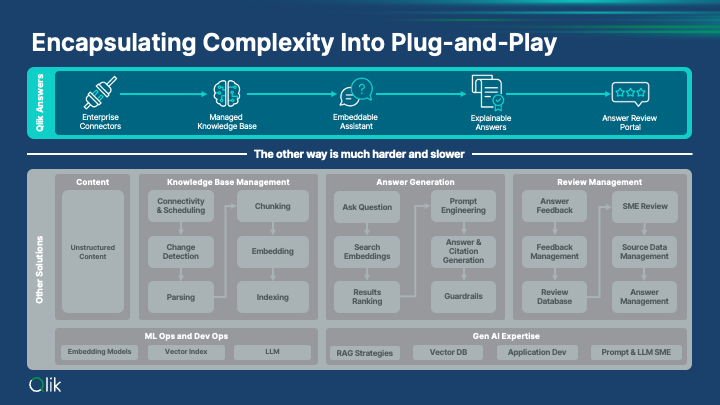
Behind the major components of Qlik Answers are over 25 different Answers-specific processes and numerous other processes of the Qlik Cloud platform. A few of the key technologies used within Qlik Answers are:
Large Language Models (LLMs) - A large language model (LLM) is a computational model notable for its ability to achieve general-purpose language generation and other natural language processing tasks such as classification. LLMs are very large deep learning models that are pre-trained on vast amounts of data. See What are Large Language Models? for more information.
Semantic search - Semantic search seeks to improve search accuracy by understanding the searcher's intent and the contextual meaning of terms to generate more relevant results. See Semantic search for more information.
Retrieval Augmented Generation (RAG) – RAG is a technique by which you include context retrieved from some form of search to generate a result. See What is Retrieval-Augmented Generation? for more information.
Qlik Analytics Engine - We have developed our own enhancements to our existing associative engine to provide the power of Qlik Analytics within Qlik Answers as well as other generative AI solutions.
Answer formulation in Qlik Answers
The following diagram illustrates the process a Qlik Answers assistant uses to answer a question across both structured and unstructured data.
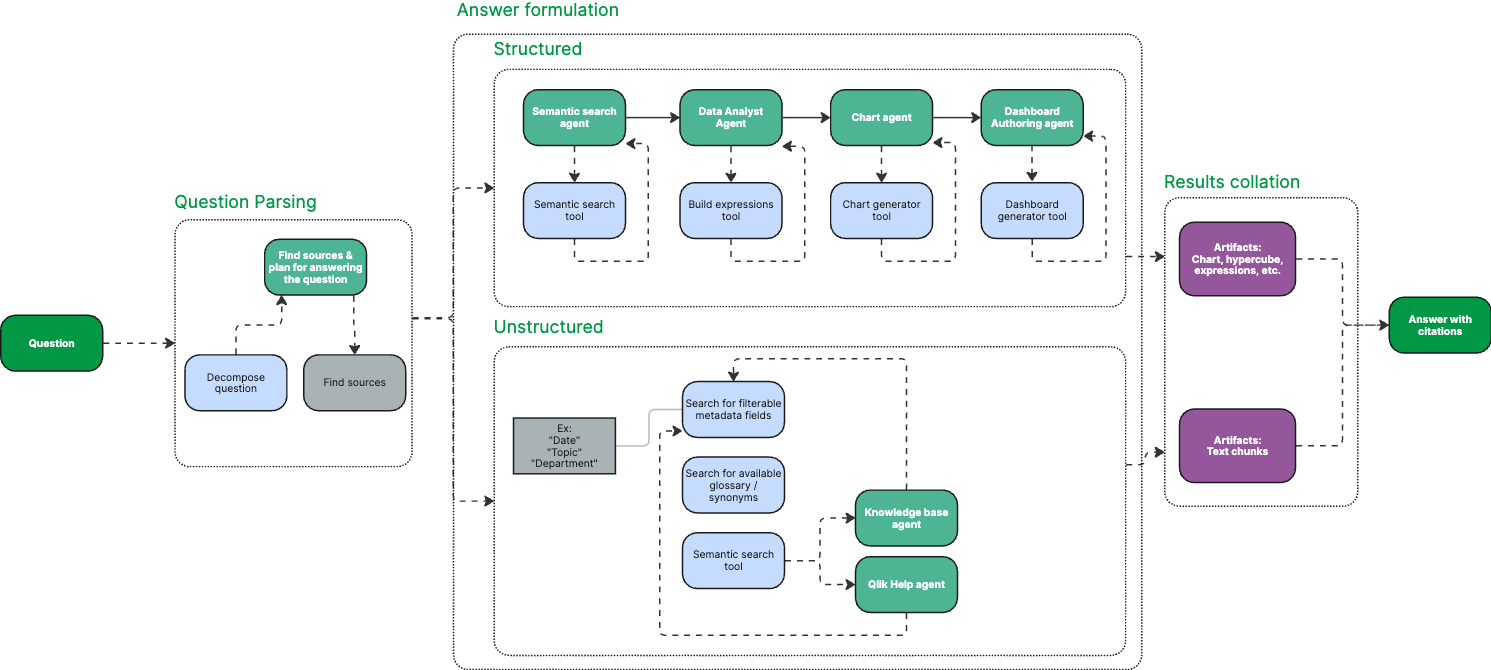
Question parsing - Answers Agent
The first thing Qlik Answers does is parse the question. This is done by the Answers Agent. It does this to determine both what the user is asking as well as which resources it has access to that are relevant to asking the question. Once it had determined this it will pass it on the parsed question and resources to the answer formulation process; this may be Structured, Unstructured or both. Specifically, the agent:
- Decomposes the user question into logical sub-task
- Identifies intent and context behind the question
- Selects and triggers the relevant tools to answer each sub-task
Answer formulation - Structured
When formulating answers on structured data, Qlik Answers first uses the Semantic Search Agent to identify the relevant master items, measures and dimensions needed to answer the question.
The Data Analyst Agent builds an analysis package that specifies
- What data to use
- How to analyze it
- What output best answers the question
It is Designed to always respect master items - Master measures and master dimensions are evaluated before raw fields. Developer defined items is treated as the trusted source - this is designed to ensure answers align with a customer's business outcomes. Business logic defined in an app is beneficial but not essential in all cases. Areas when business logic particularly benefits Qlik Answers are with synonyms and hiding fields you do not want used by the assistant.
The Chart Agent receives the analysis package from the Data Analyst Agent and then interprets execution instructions for types of visualization best suited to the data. It applies chart logic based on dimensions, measures, and intent and builds the chart as the final output.
The Dashboard Authoring Agent consumes outputs from Qlik Answers Data Analyst and Chart Agents, and translates these analytical outputs into sheet-ready objects. It helps users place, structure, and assemble content on into dashboards.
Answer formulation - Unstructured
The Knowledge Base Agent performs semantic searches through your knowledge bases (vector databases) to get relevant unstructured data and then uses RAG to pass that data to the LLM, which then provides an answer. The answer includes references back to the relevant documents that are indexed in your knowledge base.
The Help Agent is a special type of knowledge base that is provided by Qlik to customers. It contains Qlik Cloud product documentation and is designed to help you learn Qlik Cloud and take advantage of the power of our platform.
Results Collation - Answers Agent
At the end of this process, the Answers Agent takes the results from the other agents and composes their outputs back into a single, coherent answer.
Third-party technologies
The following third-party technologies are used as part of Qlik Answers at the time of writing. Qlik may choose to introduce additional or alternate technologies for Qlik Answers in the future.
Temporal - Temporal is used to distribute workflows in the file ingestion workflow (i.e. Knowledge Base indexing).
AWS Bedrock - AWS Bedrock is used as a service to connect to LLMs (Large Language Models) such as Anthropic Claude. The actual models we use change over time based on requirements and the evolution of the models.
OpenSearch - OpenSearch is the vector store that stores embeddings extracted from documents. OpenSearch is also the semantic search engine that is used to gather relevant text chunks during answer generation.
Cohere Rerank - Cohere Rerank is used to rank the most relevant embeddings returned by OpenSearch.
Amazon SageMaker - Amazon SageMaker is used to host the Cohere Rerank model.
Access control in Qlik Answers
Qlik Answers leverages the existing access control model in Qlik Cloud. Access is restricted both by space access and by roles. From a user's point of view, it is possible to provide access to the assistant and only some of the knowledge bases connected to the assistant, so certain privileged data can be restricted to only certain users. It is also possible to restrict access to the source data, so users may be able to receive an answer, but not see the document the answer was derived from. When interacting with Qlik Applications, Qlik Answers fully supports section access and users will only receive responses based on what they are allowed to see in the application.
From an administrative point of view, the same approach is used. It is possible to allow users to create an assistant against a knowledge base, without having access to change or create knowledge bases. It is possible to allow the indexing of existing knowledge bases without allowing the creation of new knowledge bases.
These controls can be assigned to users or groups and are fully governed and audit logs are available either through the platform UI or via API integration into your external systems.