
This scenario provides guidelines for how to plan geographically dispersed sites where synchronization has to be performed across two or more regions.
Node layout
In this example, the geographically dispersed site is setup as follows:
- The site consists of nodes in two geographical regions. The central node is located in region A.
- Users from both regions access apps in the site:
- Green apps are accessed by all users.
- Blue apps are only accessed by users in region B.
- Yellow apps are accessed by all users.
- The apps are characterized by the following:
- Green and blue apps are large apps where the source data is located in the respective region.
- Yellow apps are either small or fairly static (that is, they are not reloaded often).
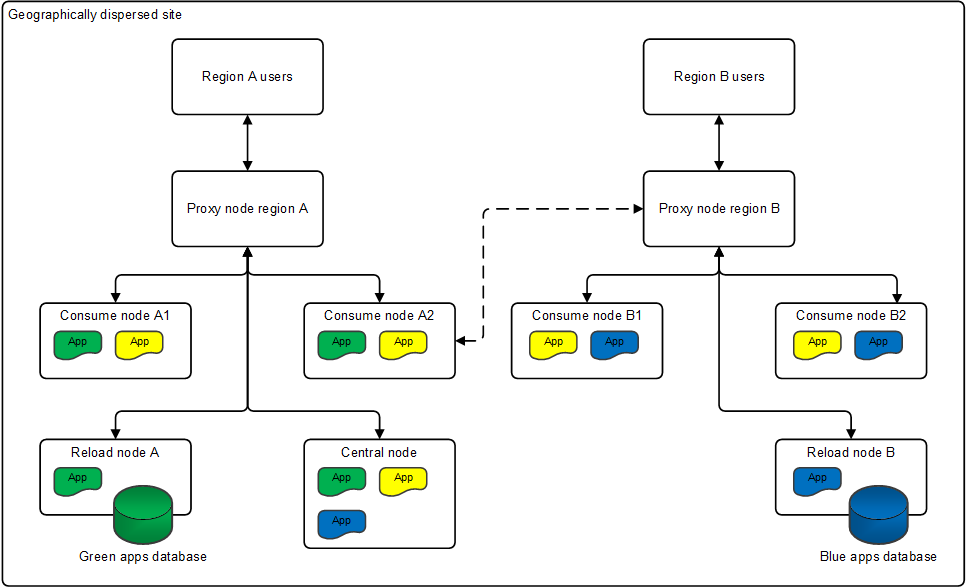
Green apps
The green apps are large enough to impact the network traffic during the synchronization. It is therefore a good idea to place them close to the data source to avoid synchronization across regions. When users from region B access the green apps, they are routed through the proxy to the A region.
Blue apps
The green and blue apps - the large apps - should be placed on nodes close to the data source to avoid synchronization across regions. However, as all apps must be available on the central node, some synchronization across regions is needed for the blue apps.
The total time needed for the blue apps to become available on the nodes in region B will be longer than the time needed for the green apps to become available on the nodes in region A. This is because of the way that the synchronization works:
- A synchronization of the updated data is initialized when a reload operation finishes.
- As soon as some segments of the updated data are available on the central node, the nodes in region B can fetch those segments.
- As synchronization across regions (for example, between Europe and North America) takes longer time than fetching data from nearby nodes, the time needed to synchronize an app increases and the central node becomes a bottleneck.
This is not a problem when synchronizing the green apps as all data segments to synchronize are available on nearby nodes in the same region.
Yellow apps
The time needed to synchronize the yellow apps is short as they are either small or not reloaded very often, which means that their impact on the network traffic is low. The yellow apps can therefore be located on nodes close to the users, minimizing the time it takes to access the apps.
Guidelines
Depending on the network capacity and the app reload frequency, the best configuration may differ. However, the following guidelines should be taken into consideration when deploying a geographically dispersed site:
- Send as little data as possible over the network and try to avoid bottlenecks when the network capacity or bandwidth is low.
- Apps that are small or are not reloaded too often can be located on any or all nodes as they do not significantly impact the synchronization performance or the user access to the apps.
- Perform reloads where the source data is.
- If an app is very large or needs to be reload often, keep the app close to its data source and on the local network. Direct any user traffic from a remote proxy across the wide area network.
- In essence, configure the site so as little as possible binary data is shuffled around in the network.