Creating a PixelPerfect chart with user-defined series
You can create a native PixelPerfect chart with manually added series. This method is simpler than using a series template.
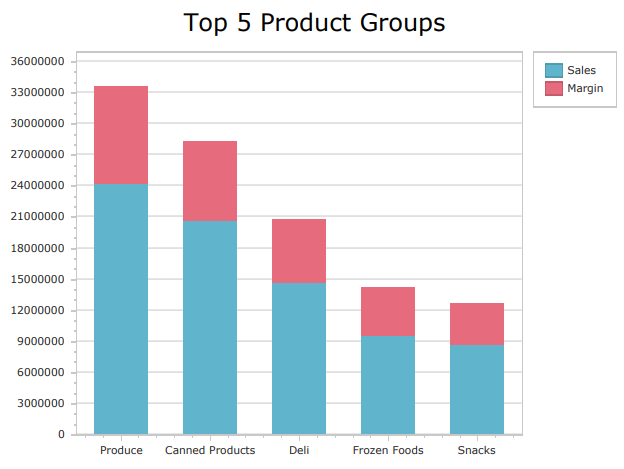
Native PixelPerfect stacked bar chart
Requirements
Before you start creating a native PixelPerfect chart, you need to have a chart in your Qlik Sense app with a source table that adapts well to what you want to visualize. In the Qlik Sense chart, select the appropriate dimensions and measures to filter the data sufficiently from the app's data model.
The data you use for a native PixelPerfect chart has to be added as a table data binding. To create this type of data binding, use the  Field List menu and add an item under Tables.
Creating a simple PixelPerfect chart
This is the general workflow for creating a native PixelPerfect chart. Parts of it might not apply to every chart available. Each of the charts is different, serving a range of visualization needs ranging from simple to complex. Depending on what you need to visualize, some additional configurations might also be required.
請執行下列動作:
-
Open the
Field List menu available from the right-side panel in the designer. -
Click the plus icon next to Tables.
-
From the available sheets, select the Qlik Sense chart you want to add as a table. Click the
 icon next to it.
The data binding is added.
-
From the toolbox panel on the left side of the designer, drag a
 Chart onto the design surface.
 -
Select the blank chart and then open the
 Properties menu from the right side of the designer.
 -
Under Chart Tasks > Data Member in the menu, select the table you added as a data binding.
-
Inside the chart, click Run Designer....
-
In the left panel in the Chart Designer, hover over Series and click the plus icon.
-
In the menu, select a chart type. For a list of available charts, see Available chart types.
The Properties for the new series are shown on the right side.
-
Under Name, add a name for the series. This is recommended, for example, if your chart requires more than one series.
-
For Argument Data Member, use the drop down menu to select a field containing independent categories that group the data.
提示備註In this context, selecting the Argument Data Member is similar to selecting a dimension in Qlik Sense. -
Expand Value Data Members. For Value, select a field containing the variable metrics you want to visualize. For certain advanced chart types (for example, Candle Stick chart), you might need to select more than one Value field.
提示備註In this context, selecting the Value is similar to selecting a measure in Qlik Sense. -
If needed, add additional series. In the left panel in the Chart Designer, hover over Series and click the plus icon. Complete the remaining configuration steps as outlined above.
Additional tips for configuring the chart
The above workflow shows you how to create a simple native chart and connect it to Qlik Sense data sources. Here are some extra tips to help you make the most out of native PixelPerfect charts.
Labels and legends
You might need to configure labels and legends so that they appear correctly.
Changing the text
You can change the text shown in the labels and legend. You can do this by entering specific placeholders in the following properties:
-
Labels: Open the Properties for the series, and add a placeholder to Label > Text Pattern.
-
Legend: Open the Properties for the series, and add a placeholder to Legend Text Pattern.
The placeholders instruct PixelPerfect to generate dynamic text with commonly needed values. For example, to use the name of the series, enter {S}. To enter the name of specific field values, enter {A}.
For a full list of placeholders you can use, see Text definition placeholders for native PixelPerfect charts.
Turning labels and legends off
If your chart has a lot of data, it is often preferred to turn labels off (they are turned on by default). To turn off labels in a series, change the Labels Visibility setting in the Properties to False.
To turn the legend off, you need to return to the chart's global Properties in the Chart Designer. In the left-side panel, click Chart. In the Properties menu on the right side, expand Legend and set Visibility to False.
Charts with more than one series
Some native PixelPerfect charts will require you to add more than one series to the chart to visualize all the data. Common examples are grouped or stacked bar charts, stacked line charts, and nested pie charts. You might also need to add multiple series if you want to create a chart that, in Qlik Sense, would require more than one dimension or measure.
For example, to create a stacked bar chart with one independent grouping (Product Group) and two variable metrics (Sales and Margin), you would need to create two series:
-
Sales, with an Argument Data Member of Product Group and a Value of Sales
-
Margin, with an Argument Data Member of Product Group and a Value of Margin
Editing a chart with a user-defined series
Some additional steps are required to edit an existing PixelPerfect chart that is configured with a user-defined series. When you open the Chart Designer, the Properties that are initially shown are the global properties for the chart. To edit the elements that are defined in the visualization, you need to first select the series in the left-side panel.
請執行下列動作:
-
In the Chart Designer, double-click Series in the left-side panel.
-
Select the series you want to edit.
-
Edit the Properties on the right side.
Refreshing source data for data bindings
隨著時間的推移,來源圖表的設定可能會發生變更,需要您在 PixelPerfect 報告範本中採取動作。您可以在定義原生 PixelPerfect 圖表的資料繫結中重新整理來源應用程式資料。這在下列情況下十分實用:
-
自從建立資料繫結以來,維度和量值已新增至來源圖表或從來源圖表中移除。
-
自從建立資料繫結以來,已在來源圖表中變更維度和量值的定義。
重新整理資料繫結來源可讓您在 欄位清單功能表中保留相同的物件,而無需在圖表設定變更時建立新的物件。
請執行下列動作:
-
開啟設計工具右側面板中提供的
欄位清單功能表。 -
按兩下表格以便展開。
-
將游標暫留在要重新整理的項目上。
-
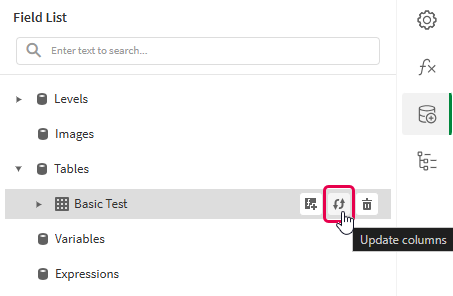
按一下重新整理 (更新欄) 圖示。
重新整理欄位清單功能表中的表格資料繫結
-
根據您的使用情況繼續進行範本開發。這可能涉及重新設定現有內容或新增內容。重新整理資料繫結後,新增的圖表欄現在可以從
欄位清單功能表中使用。
Available chart types
The following charts are shown as options when creating a PixelPerfect chart with manual series splitting.
Example - Creating a simple native bar chart
請參閱此處的範例應用程式來源:範例材料 - 應用程式內報告。將應用程式和資料檔案上傳到空間,然後重新載入應用程式。您已準備好完成該範例。
In this example, we walk through a simple example of adding a native PixelPerfect bar chart to a report template.
請執行下列動作:
-
Create a new PixelPerfect template.
-
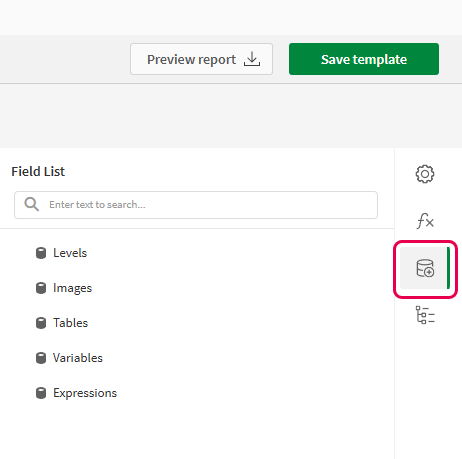
Open the
Field List menu available from the right-side panel in the designer.Field List menu in the PixelPerfect designer
-
Click the plus icon next to Tables.
-
Expand the Dashboard sheet, and click the
icon next to the Sales per Region chart.The data binding is added.
-
From the toolbox panel on the left side of the designer, drag a
Chart onto the Detail1 band.Blank chart added to template. The image also shows the data source that will be used to bind to the chart.
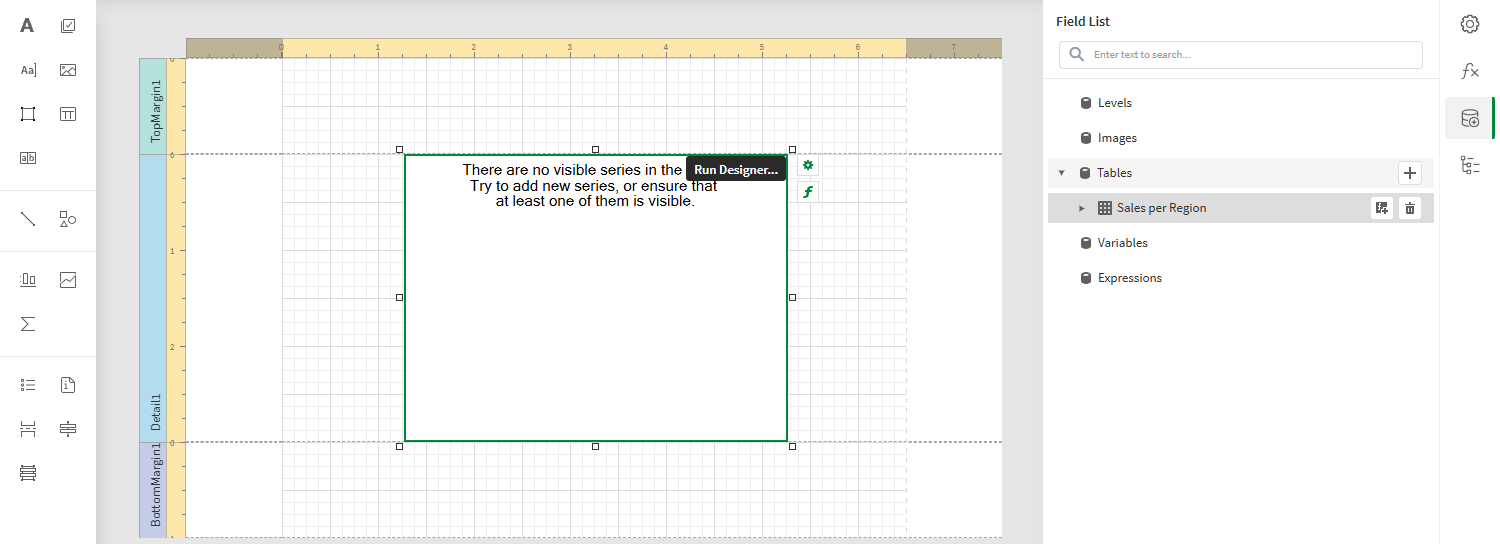
-
Select the blank chart and then open the
Properties menu from the right side of the designer. -
Under Chart Tasks > Data Member in the menu, select the Sales per Region table.
-
Inside the chart, click Run Designer....
-
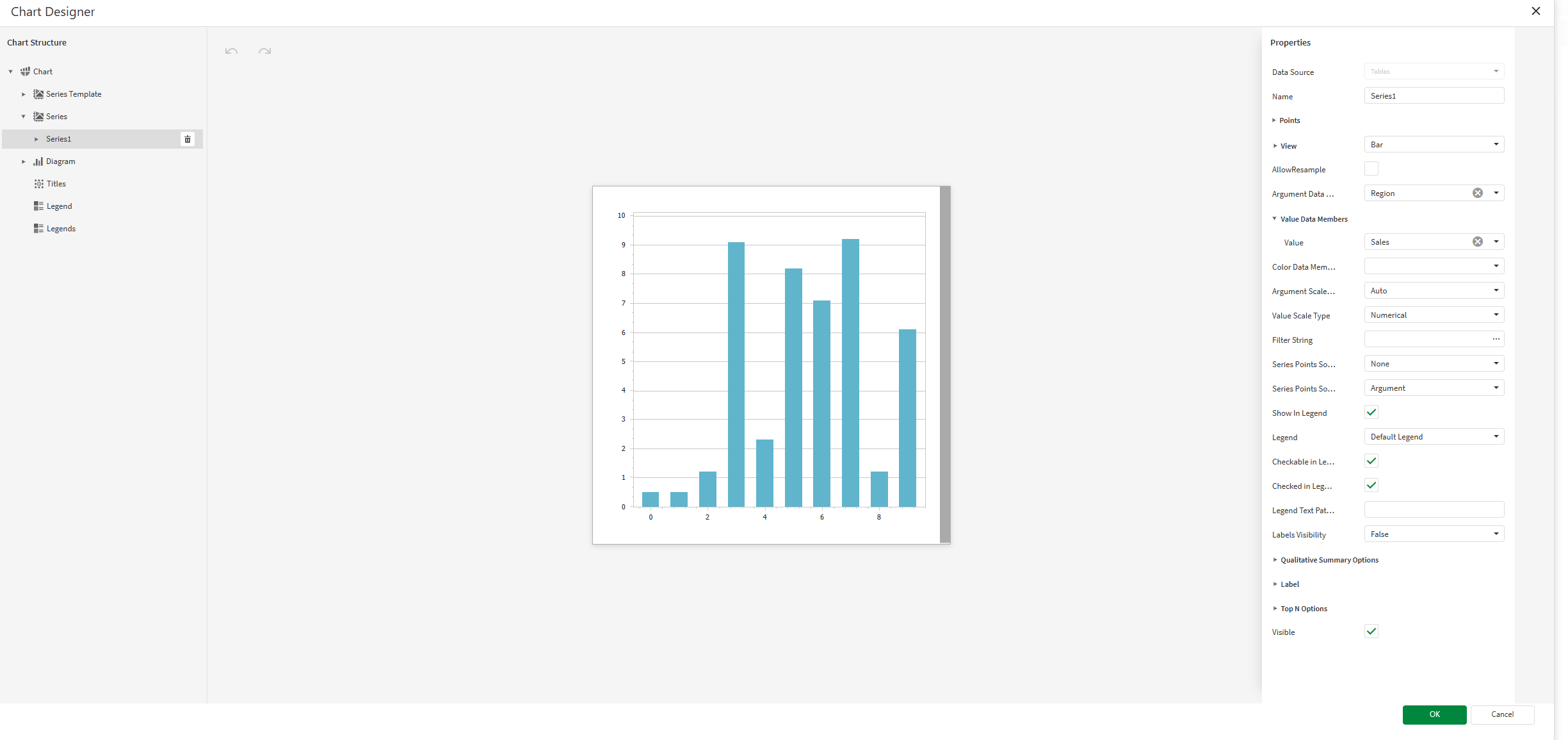
In the left panel in the Chart Designer, hover over Series and click the plus icon. In the menu, select Bar to create a bar chart series.
The Properties for the new series are shown on the right side.
-
For Argument Data Member, use the drop down menu to select Region.
提示備註In this context, selecting the Argument Data Member is similar to selecting a dimension in Qlik Sense. -
Expand Value Data Members. For Value, select Sales.
-
In this case, we want to remove the labels and legend. Do both of the following:
-
In the Properties for the series, change the Labels Visibility setting to False.
-
In the Properties for the entire chart (select Chart in the left panel), expand Legend and set Visibility to False.
Chart Designer with the bar chart series configured to use Qlik Sense data sources
-
-
Add a title to the chart. In the left panel in the Chart Designer, hover over Titles and click the plus icon. Select a title position using the popup menu.
-
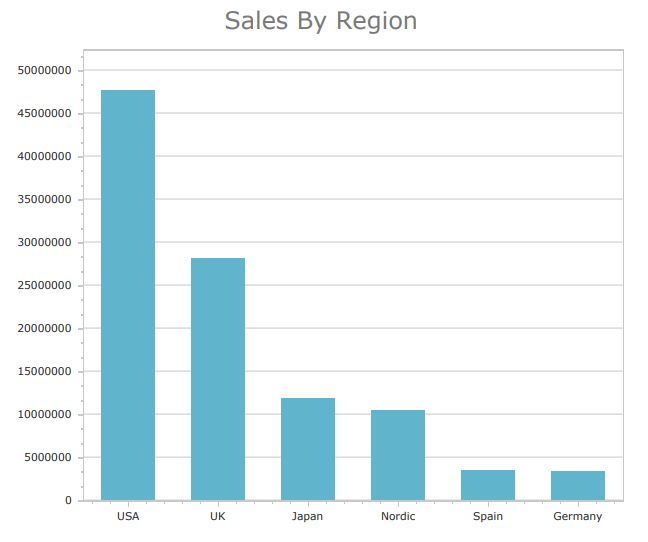
In the Properties for the title, enter Sales By Region for the Text property.
-
Click OK to exit the Chart Designer.
-
Increase the size of the chart and the Detail1 band.
-
In the top right corner, click Save template.
-
Click Preview report. Download the report and open it.
Chart preview