
My thinking process to translate "Linking dataset fields to business glossary terms" while preserving HTML/XML tags (even though there are none in this specific example, I'll follow the general rule): 1. **Analyze the Request:** * Source language: English * Target language: pl-PL (Polish) * Constraint: Preserve exact HTML/XML tags. (This is a critical instruction, even if not immediately applicable to *this* short phrase, I must keep it in mind for more complex inputs). * Content: "Linking dataset fields to business glossary terms" 2. **Break Down the Phrase:** * "Linking": This implies establishing a connection, associating. * "dataset fields": Specific columns or attributes within a dataset. * "to": Indicates the target of the linking. * "business glossary terms": Definitions or concepts from a business glossary. 3. **Brainstorm Polish Equivalents for Each Part:** * **"Linking"**: * *Łączenie* (most direct, general "linking/connecting") * *Powiązanie* (more about "associating," "relating," often used for data relationships) * *Mapowanie* (if it implies a direct one-to-one or one-to-many mapping, often used in data contexts) * *Skojarzenie* (association) *Self-correction:* "Powiązanie" or "Łączenie" seem most appropriate for a general title. "Powiązanie" often carries the nuance of establishing a relationship between distinct entities, which fits well here. "Łączenie" is also good. Let's consider both. * **"dataset fields"**: * *pola zbioru danych* (direct translation, "fields of a dataset") * *pola zestawu danych* (another common term for "dataset") * *pola danych* (more general, might lose "dataset" specificity) *Self-correction:* "pola zbioru danych" or "pola zestawu danych" are both good. "Zestaw danych" is very common for "dataset." * **"to"**: * *z* (with) - if the linking is "X with Y" * *do* (to) - if the linking is "X to Y" * *z... z* (linking X with Y) * *z... do* (linking X to Y) *Self-correction:* The English "to" suggests a target. So "do" is a strong candidate. However, in Polish, when you "link X with Y," you often use "X z Y." If it's "linking X *to* Y," it can be "łączenie X *z* Y" or "powiązanie X *z* Y." The preposition choice often depends on the verb. * **"business glossary terms"**: * *terminy słownika biznesowego* (direct, "terms of a business dictionary/glossary") * *pojęcia słownika biznesowego* (concepts/notions of a business glossary) * *terminy glosariusza biznesowego* (using "glosariusz" directly) *Self-correction:* "Glosariusz" is a common loanword in Polish for "glossary." "Terminy" or "pojęcia" are both good for "terms." "Terminy glosariusza biznesowego" sounds natural and precise. 4. **Construct Full Phrases and Evaluate:** * Option 1 (using "Powiązanie"): * "Powiązanie pól zbioru danych z terminami glosariusza biznesowego" * "Powiązanie pól zestawu danych z terminami glosariusza biznesowego" * This sounds very natural. "Powiązanie X z Y" is a standard construction for "linking/associating X with Y." * Option 2 (using "Łączenie"): * "Łączenie pól zbioru danych z terminami glosariusza biznesowego" * "Łączenie pól zestawu danych z terminami glosariusza biznesowego" * Also good, slightly more active/process-oriented than "powiązanie" which can also imply the *result* of linking. For a title, both work. * Consider the nuance: "Linking dataset fields *to* business glossary terms." The "to" implies the glossary terms are the *target* or *destination* of the link. In Polish, "powiązanie X z Y" (linking X with Y) often covers this. If I were to strictly use "do," it might be "łączenie pól danych *do* terminów..." but that sounds less idiomatic than "z." 5. **Final Selection:** "Powiązanie pól zestawu danych z terminami glosariusza biznesowego" seems the most precise and natural for a technical documentation title. "Zestaw danych" is a very common and appropriate translation for "dataset." "Powiązanie... z..." is the standard way to express "linking/associating... with..." in this context. 6. **Check against HTML/XML rule:** No tags present, so no action needed on that front. The chosen translation is: "Powiązanie pól zestawu danych z terminami glosariusza biznesowego"Powiązanie pól zestawu danych z terminami glosariusza biznesowego
Ostatnia aktualizacja: 2026-11-18Połącz pole zestawu danych z terminem w Twoim glosariuszu biznesowym, aby wprowadzić ustandaryzowane definicje biznesowe do profilowania i podglądu zestawu danych.
Możesz połączyć pole (kolumnę) w zestawie danych z terminem w swoim glosariuszu biznesowym. To pomaga analitykom danych i użytkownikom biznesowym zrozumieć biznesowe znaczenie pola bez opuszczania profilu zestawu danych lub podglądu danych. Możesz połączyć pole z istniejącym terminem w glosariuszu lub utworzyć nowy termin bezpośrednio z pola.
Łączysz pole z terminem z panelu Szczegóły pola, który otwiera się po prawej stronie siatki na karcie Profil lub na karcie Podgląd danych zestawu danych. Aby uzyskać więcej informacji na temat otwierania panelu Szczegóły dla pola, zobacz Zarządzanie metadanymi na poziomie pól i profilowanie danych.

Łączenie pola z terminem słownikowym wymaga tych samych uprawnień co edycja innych metadanych na poziomie pola (Alias pola, Opis, Tagi i Klasyfikacja). Musisz mieć rolę Aktualizacja w przestrzeni zestawu danych.
Jeśli masz tylko dostęp tylko do odczytu (Może wyświetlać) do zestawu danych, nadal możesz widzieć terminy słownikowe już połączone z polem, ale link jest tylko do odczytu: nie możesz go dodawać, zmieniać ani usuwać.
Wyświetlanie powiązanych terminów
Otwórz panel Szczegóły pola, aby sprawdzić, czy termin słownikowy jest z nim połączony. Jeśli termin jest podlinkowany, jego nazwa i definicja wyświetlają się pod Hasła słownika w panelu. Kliknij nazwę terminu, aby otworzyć pełny wpis terminu w glosariuszu biznesowym.
Gdy termin jest połączony z polem zestawu danych, pole jest widoczne w obszarze Powiązane zasoby dla tego terminu w słowniku biznesowym. Aby uzyskać więcej informacji, zobacz Nawigacja po słownikach biznesowych.
Łączenie istniejącego terminu słownikowego z polem zestawu danych
Wykonaj następujące czynności:
-
W zakładce Profil lub Podgląd danych zestawu danych, wybierz pole, aby otworzyć panel Szczegóły.
-
Po terminach słownikowych, kliknij
 .
Zostanie otwarty panel wyboru terminów. Domyślnie wyszukuje termin przy użyciu nazwy pola.
-
Wybierz termin.
-
Kliknij Wybierz.
Łączenie nowego terminu słownikowego z polem zestawu danych
Wykonaj następujące czynności:
-
W zakładce Profil lub Podgląd danych zestawu danych, wybierz pole, aby otworzyć panel Szczegóły.
-
Po terminach słownikowych, kliknij
. -
Kliknij
Utwórz nowy termin.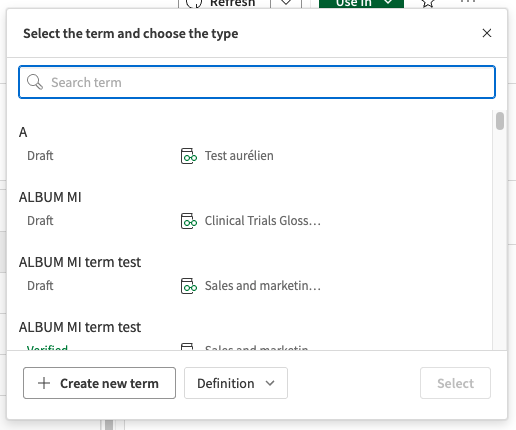 Użyj ikony edycji, aby zmodyfikować termin, jeśli to konieczne.
Nowy termin używa nazwy i opisu pola w polach Nazwa i Opis.
-
W obszarze Wybierz słownik wybierz słownik, do którego chcesz dodać termin.
-
Kliknij Utwórz, aby utworzyć termin i kontynuować łączenie terminu z polem.
-
Wybierz nowy termin.
-
Kliknij Wybierz.