# Hypercube builder
The Hypercube builder is used for building hypercubes that are not a part of the Qlik Sense app your mashup is connected to.
You access the Hypercube builder by clicking Options > Hypercubes > Add hypercube.
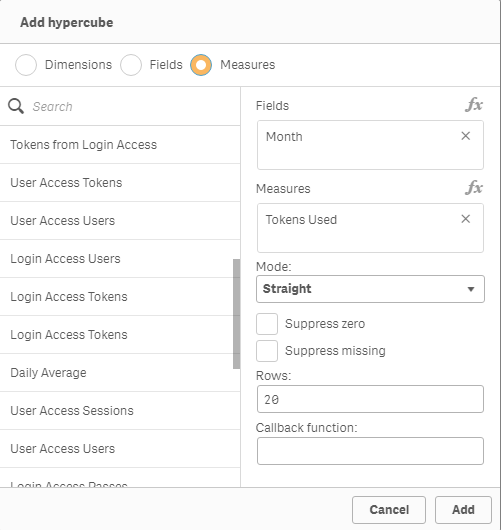
Hypercube builder items
| Item | Description |
| --- | --- |
| Dimensions | Lists all the master dimensions available in the selected app. |
| Fields | Lists all fields available in the selected app. |
| Measures | Lists all the master measures available in the selected app. |
| Field | Lists all dimensions and fields selected for the hypercube. |
| Measures | Lists all measures selected for the hypercube.
You can add an expression by clicking the Expression button. |
| Mode | Defines the way the data is handled internally by the Qlik associative engine. Select one of:
- Straight: straight table representation.
- Pivot: pivot table representation.
- Stacked: stacked table representation.
Refers to the qMode property in qHyperCubeDef. |
| Suppress zero | If enabled, zero values are removed.
Refers to qSuppressZero property in qHyperCubeDef. |
| Suppress missing | If enabled, missing values are removed.
Refers to the qSuppressMissing property in qHyperCubeDef. |
| Rows | Determines the maximum number of rows received back from the Qlik associative engine.
Refers to the qHeight of qInitialDataFetch property in qHyperCubeDef. |
| Callback | Name of your callback. |
## Code rendering in Mashup editor
When you have saved your hypercube you can go to the \*.js tab and check the code rendered by Mashup editor. The rendered code is placed at the bottom of the JavaScript file:
```
//create cubes and lists -- inserted here --
```
Example: Code rendering of added hypercube
In this example, we use the helpdesk mashup example. We add a new hypercube, select the Open Cases - High measure, and name the callback OpenCasesHigh. The following lines of code are generated by the Mashup editor and can be viewed on the \*.js tab:
```
//create cubes and lists -- inserted here --
app.createCube({
"qInitialDataFetch": [
{
"qHeight": 20,
"qWidth": 1
}
],
"qDimensions": [],
"qMeasures": [
{
"qLabel": "Open Cases - High",
"qLibraryId": "PXChPe",
"qSortBy": {
"qSortByState": 0,
"qSortByFrequency": 0,
"qSortByNumeric": 0,
"qSortByAscii": 1,
"qSortByLoadOrder": 0,
"qSortByExpression": 0,
"qExpression": {
"qv": " "
}
}
}
],
"qSuppressZero": false,
"qSuppressMissing": false,
"qMode": "S",
"qInterColumnSortOrder": [],
"qStateName": "$"
},OpenCasesHigh);
```
Mashup editor also generates the placeholder for your callback:
```
//callbacks -- inserted here --
function OpenCasesHigh(reply, app){}
```